Get Full Government Meeting Transcripts, Videos, & Alerts Forever!
Get email alerts on the State Budget topic
No spam. Unsubscribe anytime.
Licensing boards outline fee-funded budgets and workforce concerns during House Health Committee operating-budget hearing
Summary
Six professional licensing boards told the House Health Committee their operations are largely fee-funded and requested biennial spending authority; witnesses highlighted workforce data collection, mental-health supports for licensees, and the effects of recent licensure law changes on caseloads and revenue.
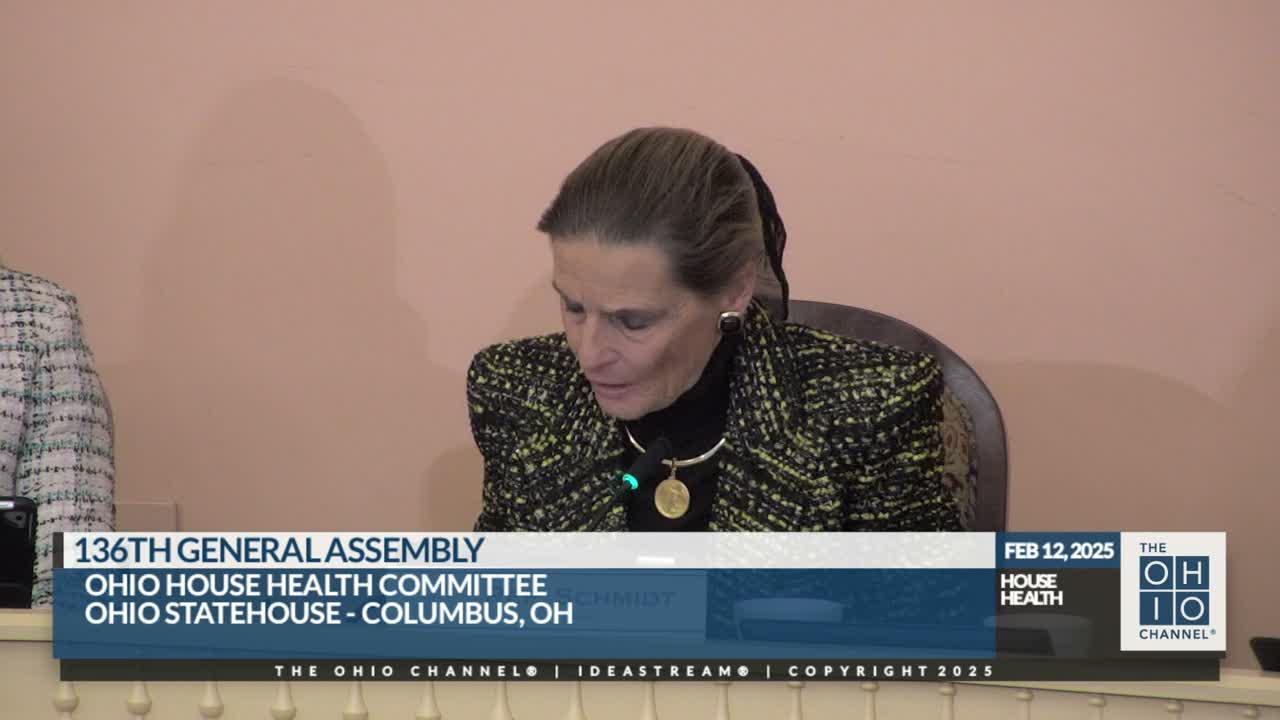
The Ohio House Health Committee opened an informal hearing on House Bill 96 (the operating budget) and invited testimony from six professional licensing boards that regulate occupations ranging from chiropractic and cosmetology to psychology and veterinary medicine. Executives from each board summarized their missions, requested biennial spending authority, and answered members' questions about workforce trends, licensure changes and enforcement demands.
Liz Moore, executive director of the Ohio State Chiropractic Board, described the board's fee-supported structure and asked the committee to grant the board's recommended FY26–27 budget to maintain operations and public protection. Lori Pearson, executive director of the Cosmetology and Barber Board, asked for spending authority of $5,523,000 in FY26 and $5,841,000 in FY27 and said the board administered 15,666 exams in FY24 and handled 1,346 complaints that year. Pearson attributed recent administrative savings and fee adjustments in part to House Bill 158 and related changes to administrative procedures.
Missy Anthony, executive director of the Occupational Therapy, Physical Therapy and Athletic Trainers (OTPTAT) board, said the board oversees more than 36,000 professionals and requested $1,352,852 for FY26 and $1,434,859 for FY27. Anthony said the board has begun collecting workforce data at licensure to better trace where professionals practice and to quantify shortages; she also highlighted the board's Safe Haven partnership with the Ohio Professionals Health Program as a confidential source of mental-health and substance-use support for licensees.
Corinne Ray, executive director of the State Board of Psychology, said the board's responsibilities expanded with House Bill 509, which transferred licensed school psychologists to the board in January 2025 and increased the licensee base from roughly 5,000 to 8,100. Ray requested $975,010 (FY26) and $1,011,722 (FY27) and said the board sought funding for a new hybrid staff position to help manage a nearly doubled investigative caseload.
Anne Gonzales, executive director of the Ohio Vision Professionals Board, requested $609,659 (FY26) and $668,146 (FY27). Gonzales told members that some optometrists appear to be leaving Ohio because neighboring states allow expanded scope-of-practice procedures (for example, laser treatments) that Ohio currently does not permit, affecting retention.
Jacob Bell, executive director of the Ohio Veterinary Medical Licensing Board, requested $653,000 (FY26) and $675,000 (FY27) (totaling approximately $1,328,000). Bell reported a roughly 40% increase in complaints in 2024, described the board's limited jurisdiction (not covering fee disputes or boarding issues), and outlined a scholarship funded by $10 of each renewal fee to encourage veterinarians to practice in underserved agricultural areas; scholarships range from $10,000 to $20,000 for service commitments.
Committee members pressed the witnesses on workforce data, continuing education cycles and whether compacts or scope-of-practice changes were under consideration. Several presenters recommended follow-up information for members; Chair Schmidt closed the informal hearing after votes and testimony were concluded.