Get Full Government Meeting Transcripts, Videos, & Alerts Forever!
Get email alerts on the Procurement topic
No spam. Unsubscribe anytime.
Ohio House committee hears bipartisan HB 284 to require American-made iron and steel on state projects
Summary
Sponsors told the House Development Committee that House Bill 284 would expand an existing steel preference to include iron, requiring state-funded projects to use American-made steel and iron; sponsors said the law would support Ohio manufacturers and union jobs, and vowed to clarify specifications and enforcement details.
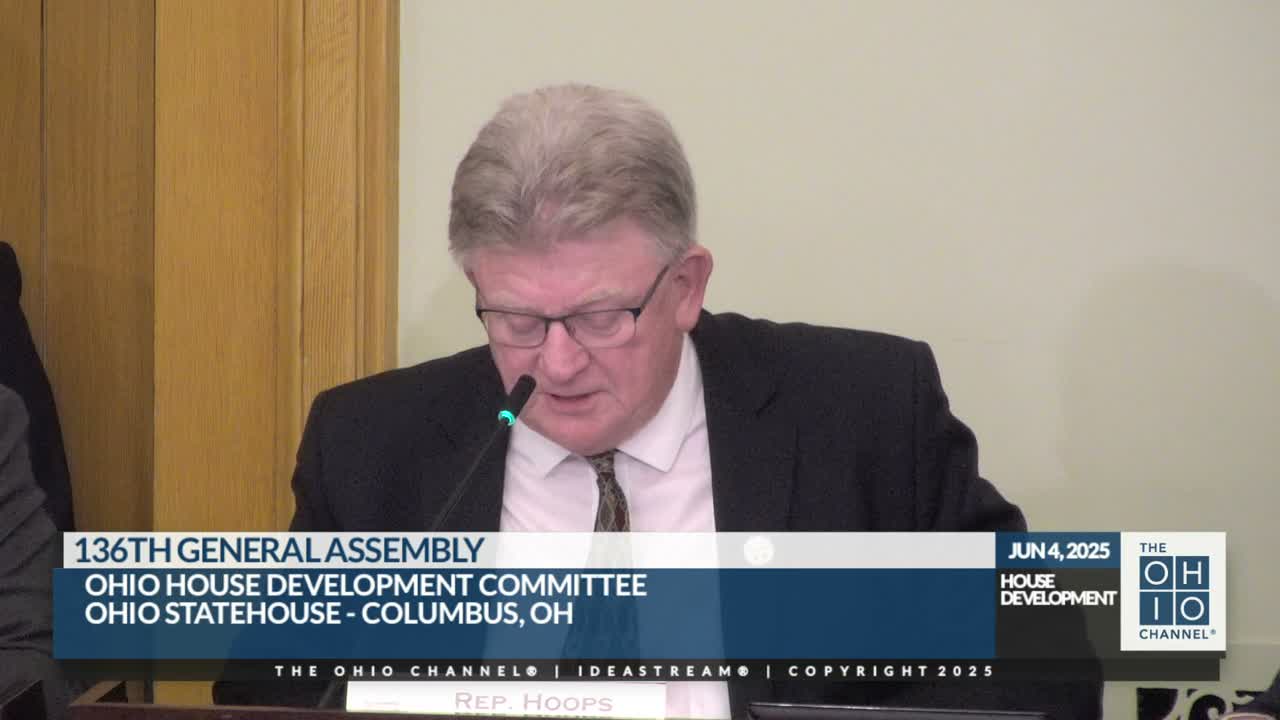
Representatives testifying before the House Development Committee on Wednesday urged support for House Bill 284, a bipartisan measure that would require state-funded construction projects to be built with American-made iron and steel.
"It requires that state funded projects be constructed of American made steel and iron," Representative Heiner said in sponsor testimony, arguing the change would "support our domestic supply chain, promote manufacturing jobs, and help ensure our state investments stand the test of time." Representative White, a joint sponsor, said the bill updates a requirement first enacted in the late 1970s and would align Ohio with other states that have similar laws.
The bill’s sponsors framed HB 284 as an economic and durability policy. White referenced manufacturing hubs in the state, citing the Toledo Assembly Complex and Cleveland Cliffs operations and saying the measure would "represent significant investment in Ohio's future and Ohio workers." Representative Heiner pointed to McWane Ductile in Coshocton as a company that could benefit.
Committee members pressed sponsors on specifics. Representative Fisher asked whether state projects currently use foreign-sourced iron; the sponsors said they would research examples from other states and provide that information to the committee. Representative Johnson asked how enforcement and penalties would work and whether specifications would cover bolts and fasteners used in structural projects. The sponsors said existing statute assigns enforcement to the director of public works and that penalties under the current framework are paid to the local school district; they also said the statutory phrasing "up to and including" likely would encompass bolts, torques and fasteners but promised to clarify the language.
Sponsors and members discussed exceptions to avoid delaying work if specified materials are unavailable. White said the committee should craft language that supports American manufacturing without halting projects, and both sponsors agreed to follow up with clarified statutory language and examples.
The committee concluded the first hearing on HB 284 with no formal vote; sponsors were thanked and told they would provide requested clarifications to members.
Next steps: HB 284 received a first hearing; sponsors said they would return additional information on prior use of foreign-sourced materials, confirm whether the bill’s language explicitly covers fasteners and torques, and detail enforcement and penalty mechanics.