Get Full Government Meeting Transcripts, Videos, & Alerts Forever!
Get email alerts on the Lead Service Line Replacement topic
No spam. Unsubscribe anytime.
Sponsors outline 15-year plan in House hearing for Lead Line Replacement Act
Summary
Sponsors of House Bill 307 told the House Development Committee the bill would require public water systems in Ohio to identify and replace lead service lines over 15 years, provide interim filters and education, prohibit shutoffs for inability to pay, and include prevailing-wage and workforce-training provisions; sponsors estimated statewide replacement would cost roughly $4–5 billion.
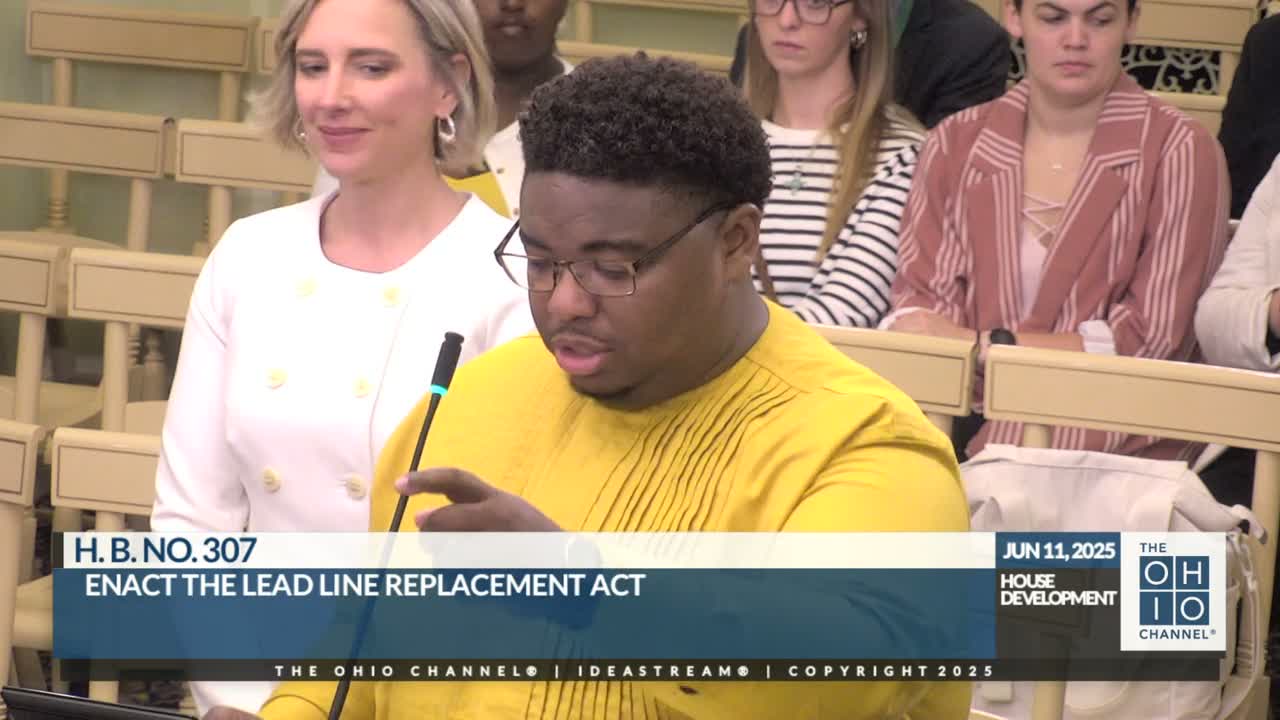
Representatives Jerrells and Rob Blaisdell told the House Development Committee that House Bill 307, the Lead Line Replacement Act, would require publicly owned water systems in Ohio to identify and replace lead service lines statewide over a 15-year period.
“This is a lead pipe,” Representative Jerrells said as he held up a section of piping to the committee, adding that he speaks from personal experience as “a survivor of lead poisoning.” He said the bill would remove what he described as roughly 745,000 legacy lead service lines in Ohio, require filters and education to protect families during partial replacements and bar service shutoffs for households unable to pay replacement costs.
Blaisdell, the bill’s joint sponsor, told the committee the Ohio Environmental Protection Agency would oversee program planning and execution, and the measure would include prevailing-wage requirements and training and certification programs for workers performing the replacements. “This legislation aims to keep our communities safe and healthy by implementing a comprehensive regulatory framework to plan, execute, and assist in the replacement of all lead water lines in the state of Ohio,” he said.
Committee members pressed sponsors on cost and timing. When Representative Seegress asked for an estimate, sponsors said replacing an estimated 745,000 service lines would cost roughly $4 billion to $5 billion overall and noted the federal infrastructure package and a $45 million state allocation for line mapping as initial funding sources. Sponsors also told the committee the U.S. Environmental Protection Agency has a 10-year expectation for lead-service-line removal but said they set a 15-year timetable to accommodate mapping and funding gaps in some communities.
Representative Johnson, describing constituents in a high-poverty county, said many households lack any running water and pressed the group on how the state would prioritize communities that do not yet have service. Johnson said he supported the bill’s goal but urged attention to communities that need basic water access before replacement projects begin. Representative Demetrio asked that any funding streams include accountability measures so money reaches local implementers rather than being tied up in administrative processes.
Sponsors told the committee they were willing to consider guardrails and changes to strengthen accountability. The chair concluded the committee’s first hearing on HB 307 with no formal vote recorded at the session.
The committee is expected to continue consideration of the bill in future proceedings.