Get Full Government Meeting Transcripts, Videos, & Alerts Forever!
Get email alerts on the Postsecondary Pathways topic
No spam. Unsubscribe anytime.
Sponsors present GRAD Act to require exit-orientation programs linking seniors to jobs, training and local services
Summary
Rep. Williams and Rep. Santucci presented House Bill 119 (the GRAD Act), which would direct the Department of Educational Workforce to create an exit-orientation for 11th–12th graders to connect students to education, apprenticeships, OhioMeansJobs and local health resources; sponsors said they do not expect major new district costs and said DEW would adopt rules.
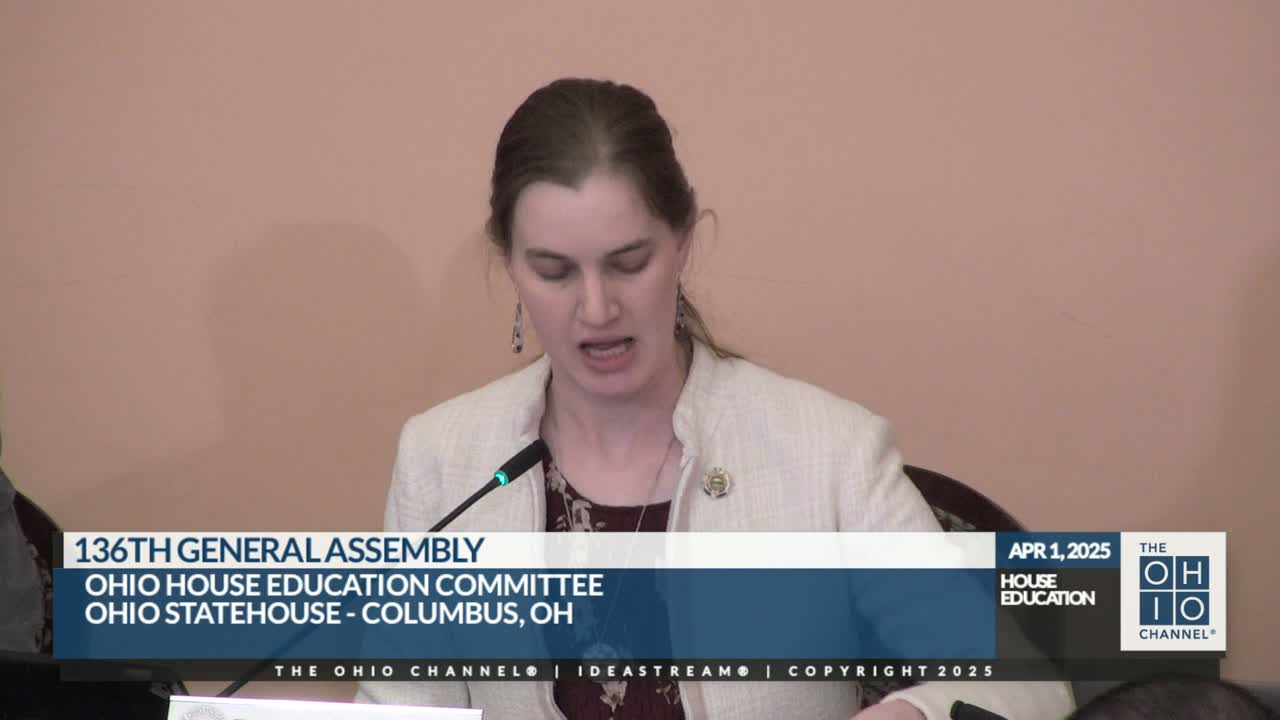
Representative Williams and Representative Santucci introduced House Bill 119, the Graduation Readiness and Development (GRAD) Act, in sponsor testimony to the House Education Committee.
"Under this legislation, the Department of Educational Workforce must formulate an exit orientation program for eleventh and twelfth grade students to be administered by their school or school district," Representative Williams told the committee, listing resources the program would highlight, including federal student loans, state grant programs, local apprenticeships, OhioMeansJobs and local health and STD testing facilities.
Sponsors said the program aims to give juniors and seniors a structured way to learn about postsecondary options beyond a four‑year degree. "By diversifying and illuminating the options available to these students, we can help them make informed decisions about their future," Williams said.
Representative Santucci emphasized labor-market alignment, citing that many in‑demand jobs in the state do not require a four‑year degree and that the exit orientations would involve local workforce development boards and Jobs Ohio to tailor programming to local needs.
Committee members raised operational and fiscal questions. Representative Robinson asked about costs to districts; Williams replied they "don't anticipate any additional cost" and that the events would be coordinated with agencies that already provide resources. On whether attendance would be mandatory, Williams said the bill requires schools to make the orientation available but would not tie attendance to graduation and that DEW could craft waiver processes for students already committed to particular postsecondary paths.
Members from smaller districts stressed coordination burdens and promotion needs, warning that hosting multiple employer partners may require staff time. Sponsors said they have discussed the bill with Educational Service Centers and OhioMeansJobs and are open to amendments to accommodate smaller districts and career‑technical centers.
The committee held the first hearing; sponsors said they expect proponent testimony to follow and that DEW rulemaking will refine implementation details. No vote was taken on HB 119 during this session.