Get Full Government Meeting Transcripts, Videos, & Alerts Forever!
Get email alerts on the Teacher Professional Development topic
No spam. Unsubscribe anytime.
Lawmakers propose reimbursable implicit‑bias training for Ohio educators
Summary
House Bill 165 would require reimbursement to schools for graduate‑level implicit‑bias credits or CEUs and task the State Board, Chancellor and DEW with setting minimum standards; sponsors proposed $750,000 per fiscal year for reimbursement. Committee received brief questions and closed the first hearing.
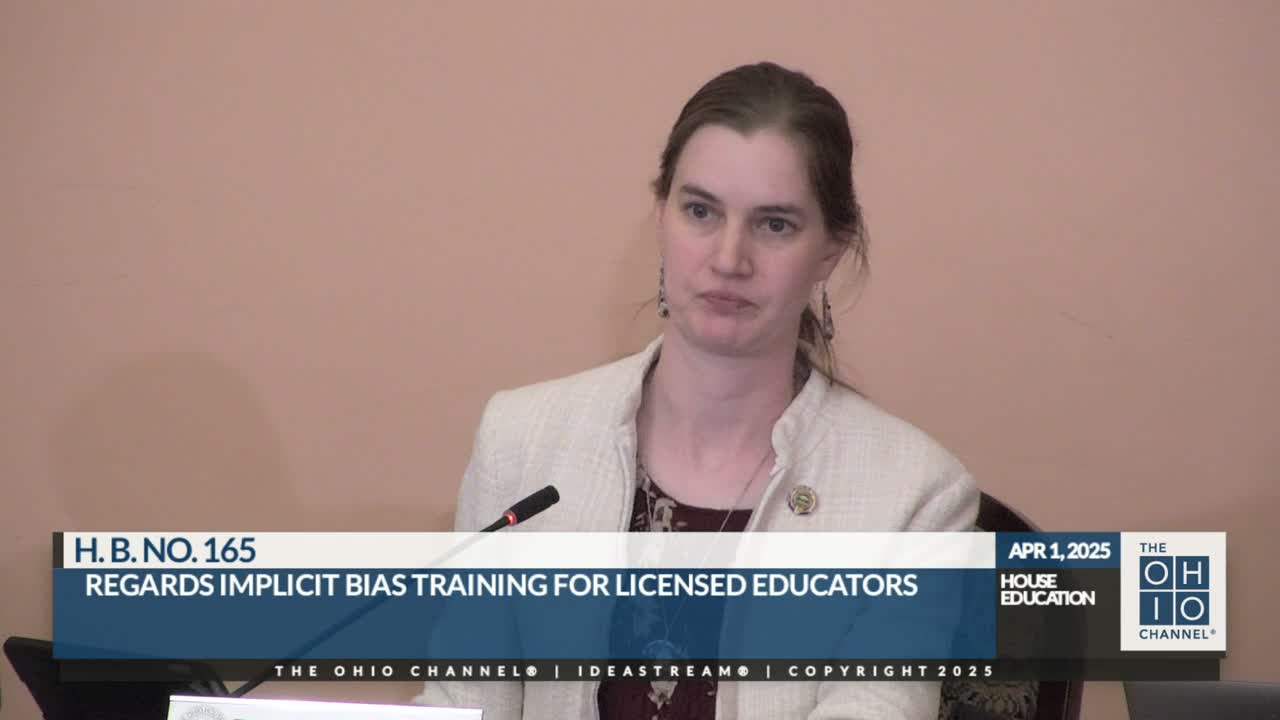
Representatives Joe Miller and Brewer presented House Bill 165 in a first hearing, proposing a voluntary, reimbursable pathway for licensed educators in Ohio to receive implicit‑bias training that could count toward recertification.
Under the sponsors’ proposal, the State Board of Education and the Chancellor of Higher Education would establish the number of reimbursable credit hours and continuing‑education equivalents, and the Department of Education and Workforce would reimburse schools for funds spent on employee implicit‑bias training. The bill includes an appropriation of $750,000 for each fiscal year 2026–27 to support reimbursements.
Representative Miller described the training as professional development that would not “indict” educators but would give them tools to better support student outcomes. Representative Brewer emphasized research showing implicit bias can influence classroom interactions and discipline, and said the bill aims to create a uniform, reimbursable option so educators statewide can access standardized, vetted training.
Committee members asked whether current law or rules already permit voluntary participation in implicit‑bias training for continuing education or LPDC recommendations. Sponsors said they were not aware of a prohibition and framed the bill as expanding structured, reimbursable options under State Board standards.
No vote occurred; the chair closed the hearing and sponsors offered to answer follow‑up questions.