Get Full Government Meeting Transcripts, Videos, & Alerts Forever!
Get email alerts on the Education Workforce Transition topic
No spam. Unsubscribe anytime.
Sponsors pitch GRAD Act to connect juniors and seniors with workforce and life supports
Summary
Representatives Williams and Santucci testified for House Bill 119 (GRAD Act), which would require DEW to establish exit-orientation programs for 11th–12th graders to link students to education, apprenticeship, health resources and OhioMeansJobs; members raised questions on costs, local control and implementation for small districts.
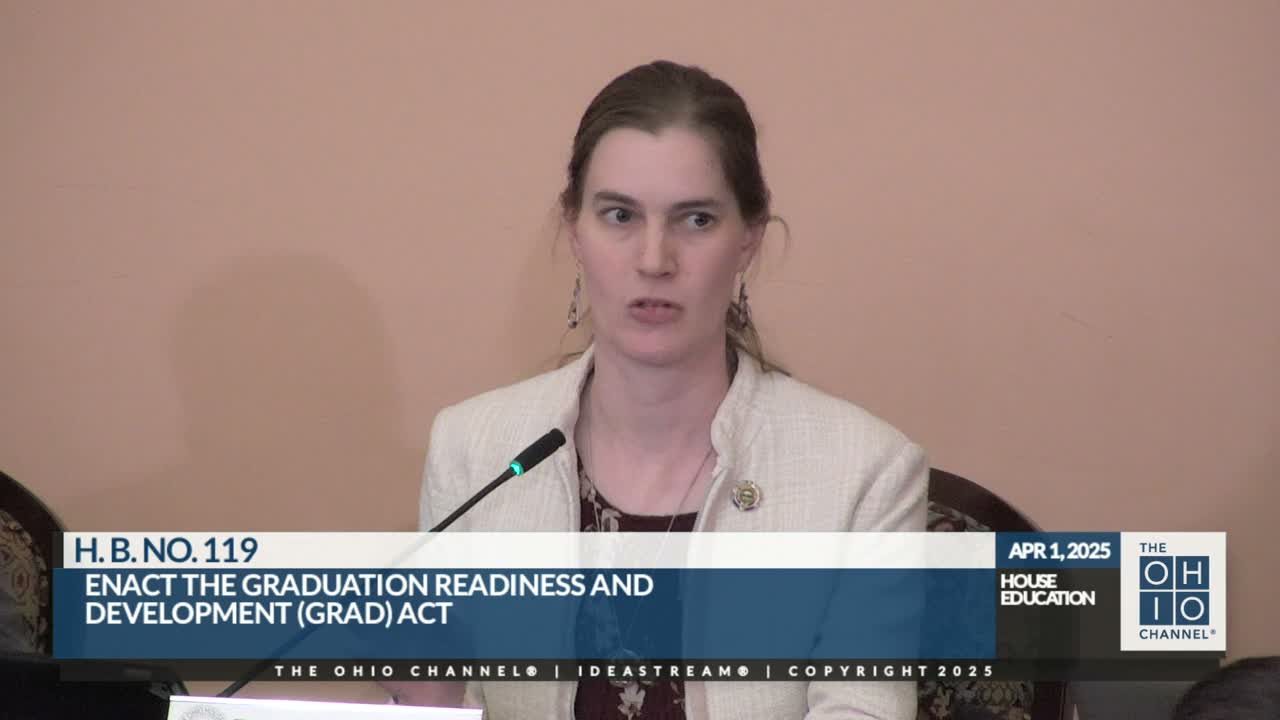
Representative Williams and Representative Santucci urged the House Education Committee to advance House Bill 119, the Graduation Readiness and Development (GRAD) Act, during a first hearing in which sponsors described the proposal as an “exit orientation” program to help 11th- and 12th-grade students make post‑high‑school decisions.
The bill would direct the Department of Education and Workforce (DEW) to formulate statewide exit‑orientation programming administered by schools or districts. Sponsors described the sessions as broader than typical career fairs and said they would connect students to federal and state financial‑aid information, apprenticeships and technical training, OhioMeansJobs centers, local internships, military enlistment options and local health‑care and STD‑testing resources.
“By diversifying and illuminating the options available to these students, we can help them make informed decisions about their future,” Representative Williams said in sponsor testimony. Representative Santucci cited job‑market data and said many in‑demand Ohio jobs do not require four‑year degrees, arguing for earlier exposure to non‑traditional pathways.
Why it matters: Sponsors framed HB119 as a statewide, uniform framework to ensure every graduating student has exposure to postsecondary and workforce resources regardless of their county. The bill aims to reduce student debt and improve labor‑market matches by broadening awareness of apprenticeships, vocational training and other alternatives to a four‑year degree.
Committee questions and concerns: Members asked how the program would affect school budgets and staffing. Representative Robinson pressed whether local districts would incur additional costs; Representative Williams said sponsors do not anticipate new spending because the events would be coordinated with existing government agencies and workforce centers, though he acknowledged districts routinely request funds when mandates are introduced. Representatives raised equity questions for small or rural districts with limited administrative capacity; sponsors said they are open to amendments and to working with Educational Service Centers (ESCs) for coordination.
On scope, Representative Miller asked why information about local health‑care clinics and STD testing was included. Representative Williams replied the provisions arose from local workforce and community‑health conversations and juvenile STD prevalence statistics and characterized the measure as supporting transition to adult life, not as lobbying by outside entities.
What’s next: Sponsors told the committee they expect to refine language through amendments and stakeholder feedback; the committee scheduled proponent testimony as the bill moves through committee process. No formal vote occurred at the hearing.