Get Full Government Meeting Transcripts, Videos, & Alerts Forever!
Get email alerts on the Hazard Mitigation topic
No spam. Unsubscribe anytime.
Emeryville adopts 2025–2030 Local Hazard Mitigation Plan after council debate over Cal Fire language
Summary
Council adopted the city’s 2025–2030 Local Hazard Mitigation Plan 3–2 after debate about whether to insert Cal Fire map language clarifying Emeryville is not in high wildfire-hazard zones; a proposed amendment to insert a Cal Fire paragraph failed.
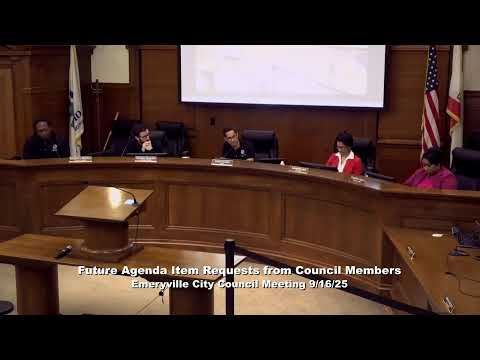
The Emeryville City Council adopted the 2025–2030 Local Hazard Mitigation Plan (LHMP) on Sept. 16 after a prolonged discussion about whether to insert Cal Fire language clarifying that the city is not designated on Cal Fire’s high or very-high fire hazard severity maps.
Vice mayor Kerr pushed to add Cal Fire wording and maps into the plan to help homeowners associations with pooled insurance and said she had previously requested that language: "I had asked that the hazard mitigation plan include the maps indicating Emeryville is not in the severe fire zone," she said. City staff said they had added maps and explanatory language to the city website but that changing the officially submitted LHMP would require resubmission to Cal OES and FEMA and could trigger a months-long review.
Laurie Elephant, who worked on the local mitigation plan, told the council: "It does say in the plan that Emeryville is not subject to wildfires," and staff noted the plan already refers to Emeryville’s low wildfire susceptibility because of topography and urban density, while emphasizing urban/structure fire risk.
Council debated whether adding a sentence or paragraph drawn from Cal Fire would materially affect insurance underwriting. Staff and a municipal representative (Pedro) said the state insurance commissioner has advised that Cal Fire maps are not a factor insurance companies use to determine rates.
After discussion, Vice mayor Kerr made a substitute motion to add the Cal Fire-derived language and a link to the maps; the substitute was seconded. The substitute motion failed on roll call (Ayes: Council member Preyforce, Vice mayor Kerr; Nays: Council member Solomon, Council member Welch, Mayor Mora). The council then voted on the original adoption motion and carried it with three aye votes and two no votes (Ayes: Council member Solomon, Council member Welch, Mayor Mora; Nays: Council member Preyforce, Vice mayor Kerr). The resolution adopting the LHMP was therefore approved.
A member of the public, Doug Jones, urged the council to weigh earthquake readiness and hospital surge capacity in hazard planning, warning of a nearby fault that “might be as strong as a 7.2 earthquake.” Staff acknowledged earthquake hazards were a major consideration in the plan and emphasized FEMA reimbursement and mitigation steps are part of the document.
Why it matters: adoption of the LHMP makes the city eligible for certain mitigation grants and formalizes priorities for hazard reduction and post-disaster recovery. Debate over Cal Fire wording reflected local concern that plan language and the availability of supporting materials affect homeowners and HOAs.
Next steps: the adopted plan will remain on record and staff said they can include supplementary materials (maps and explanatory text) on the city website; staff offered to explore whether a limited amendment could be submitted to Cal OES/FEMA without a full restart of the multi-year review process.