Get Full Government Meeting Transcripts, Videos, & Alerts Forever!
Get email alerts on the Discipline Code topic
No spam. Unsubscribe anytime.
Ossining board adopts revised code of conduct after public hearing; committee emphasizes restorative approach
Summary
After a public hearing and committee presentation, the Ossining Union Free School District Board of Education voted to adopt a revised district code of conduct that shifts language toward restorative practices, removes criminalizing terminology, and aligns discipline procedures with a progressive PBIS rubric.
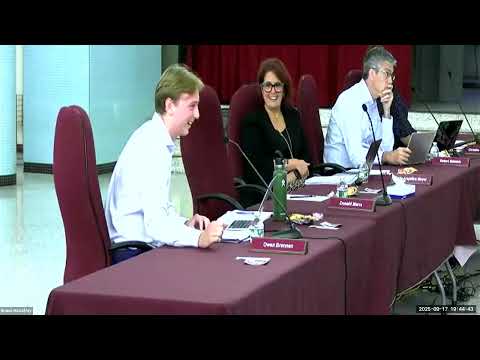
The Ossining Union Free School District Board of Education on Sept. 17 adopted a revised district code of conduct after a public hearing and committee presentation that framed the changes as a move from punitive language and practices toward restorative, equity‑focused discipline.
Anne Dealey, presenting on behalf of the code of conduct committee, told trustees that the proposed edits reflect state guidance and local data review and were posted for public comment for at least 30 days. Dealey said the revisions emphasize five themes: aligning the code to the district's vision, defining and integrating restorative practices, aligning language and procedures with the district's progressive behavior intervention and support (PBIS) rubric, revising gendered language, and removing criminalizing terminology that can feed the school‑to‑prison pipeline. She described changes to the minor incident form, school‑level rubrics, and teacher guidance intended to clarify responses to classroom behaviors while reserving removal or out‑of‑school time for higher‑level, risk‑based incidents.
Dealey cited national and state recommendations — including 2023 guidance from the New York State Attorney General and the state education commissioner — as background for the committee's work. The presentation emphasized disaggregated behavior data as the basis for changes and described professional development, school‑specific calibration of the rubric, and a plan for collecting demographic data related to policy enforcement. Dealey said the revised code ties the district's acceptable use and remote learning policies to the code of conduct and specifies that no suspensions should be used solely to enforce the Internet‑enabled device policy.
During trustee Q&A, staff and trustees discussed how the revisions will be implemented and tracked. Trustees asked about who may file incident reports on buses (administration said bus drivers and monitors can write referrals but only school administrators can issue behavioral consequences), how vaping incidents are handled, and procedures for serious or threatening conduct (administration said high‑risk behaviors may still result in out‑of‑school time determined by administration after a risk assessment). Administrators said they will continue to collect and disaggregate incident data and can provide requested intervals of reporting to the board.
Following the public hearing, the board moved to adopt the resolution (agenda item 5.1). A trustee moved the resolution and another seconded it; the board approved the measure by voice vote.
What changes and next steps mean: the newly adopted code is intended to make disciplinary language more descriptive of behavior rather than labeling students, to expand restorative responses and supports, and to standardize the use of a progressive rubric and minor incident form across schools. Administrators said they will carry out training for staff, provide materials to teachers, and bring disaggregated outcome reporting back to the board on request. The code will take effect per the district's usual implementation schedule; the administration indicated it will present periodic updates on metrics and implementation milestones.
Authority and context: the superintendent read the statutory basis for the hearing under Education Law section 2801‑a and 8 NYCRR 155.17 at the start of the hearing. Dealey repeatedly referenced the 2023 guidance from the New York State Attorney General's office and the New York State Education Department as informing the committee's approach.
The board closed the hearing with no public speakers and then approved the adoption. The administration said it will circulate implementation materials and return with data on outcomes as requested by the board.