Get Full Government Meeting Transcripts, Videos, & Alerts Forever!
Get email alerts on the Aab Training And Access topic
No spam. Unsubscribe anytime.
State Board of Equalization work group urges statewide AAB training, simpler appeals and language access
Summary
County officials told the State Board of Equalization work group they need BOE‑led, plain‑language training, simplified assessment appeal forms, better language translations and a legal interpretation clarifying whether counties may temporarily use AAB members from other counties. LA County highlighted virtual hearings and backlog reductions.
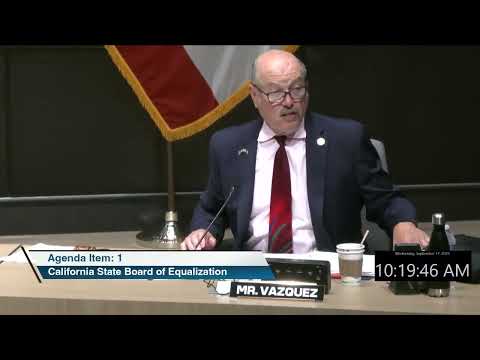
The State Board of Equalization convened a work group on assessment appeals that heard a series of county proposals aimed at reducing backlog and improving the capacity and consistency of assessment appeals boards (AABs) across the state.
Jennifer Tran, representing the Los Angeles County Executive Officer’s office, described LA County’s training and outreach programs and said the county’s 2021 move to a virtual hearing platform expanded capacity. "LA County was able to increase the number of board hearings from 5 to 8 boards per day," Tran said, and the county reported using video tutorials and a resource center with closed captions and auto‑translate to reduce in‑person and telephone inquiries.
The LA County presentation included concrete proposals the board might consider: BOE‑sponsored annual conferences for AAB members, a statewide AAB registry for temporary assistance between counties, and development of non‑county‑specific video tutorials. Tran also recommended a simplified appeals form for single‑family homeowners and a statewide portal, with state funding, to coordinate county needs and systems.
Thomas Parker, county counsel who advises Los Angeles County’s AAB panels, urged the BOE to issue a legal‑interpretation (LTA) clarifying whether one county may temporarily use another county’s AAB members to compose panels when a county cannot field a three‑person board. "A clear interpretation of existing state law on this question would be very helpful," Parker said, citing recent Revenue and Taxation Code provisions he said have expanded categories of qualified appointees.
Several members of the board and county presenters described practical consequences when small or rural counties cannot fill panels: applicants could stipulate to two‑person panels, but that requires agreement from both parties and carries risks; the statutory multi‑county AAB process exists but can be onerous to set up. Board members repeatedly asked for clarity on residency requirements for appointees and whether temporary cross‑county appointments are permissible.
San Diego County Assistant Clerk Anne Moore urged more plain‑language guidance and on‑demand case‑law briefings for non‑attorney members. "What's missing is a universal resource that any board member in any county can use and trust," Moore said, recommending annual case‑law updates led by BOE attorneys and short, plain‑language modules on terms such as "good cause."
Bhavita Madvani, deputy county counsel for Santa Clara County, recommended that BOE create training modules tailored to common property types, produce quick‑reference tip sheets for on‑the‑job use, simplify the assessment appeals application to reduce delays caused by mis‑completed forms, and publish core guidance in multiple languages. Madvani noted that some translated BOE publications lag the English version and asked that translations be updated to match current guidance.
Yvette Starz, BOE executive director, and David Young, deputy director of the property tax department, described the board’s existing catalog of training, self‑study options and certification test. Young said the statutory certification can be completed within a year and noted in‑person and online options are available; he acknowledged concerns about the time commitment for smaller‑county volunteers.
Across presentations, county representatives urged three near‑term BOE steps: (1) develop plain‑language, on‑demand training and annual case‑law briefings; (2) simplify and translate the appeals application and core publications; and (3) issue an interpretive LTA addressing whether counties may temporarily utilize AAB members from neighboring counties to constitute hearing panels. No formal votes were taken; the meeting recessed for lunch and was scheduled to reconvene.
What happens next: the BOE work group will take the recommendations under advisement as it drafts best‑practice guidance and considers whether to issue an LTA addressing cross‑county appointment authority. The meeting resumed after a lunch recess at the time announced by the board.