Get Full Government Meeting Transcripts, Videos, & Alerts Forever!
Get email alerts on the Jail Based Treatment topic
No spam. Unsubscribe anytime.
Wyoming health officials, sheriffs back bill letting jails provide treatment, request $2.5M a year
Summary
The Wyoming Department of Health and sheriffs are asking the Legislature to authorize voluntary contracts with county jails to provide evaluations and treatment for Title 7 (forensic) detainees and to appropriate roughly $2.5 million a year to reimburse holding and treatment costs and incentivize local restoration services.
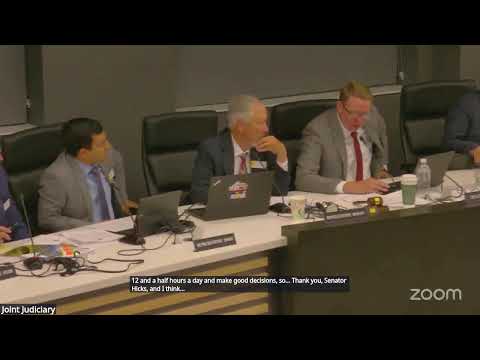
The joint Judiciary Committee on Tuesday heard a proposal from the Wyoming Department of Health to let county jails contract with the department to provide secure examinations and psychiatric treatment for defendants ordered under Title 7.
Department Director Stefan Johansen told the committee the state hospital—s forensic wait list remains ‘‘hovering around 4 to 5 months’’ from the issuing of a court order to inpatient admission, which forces counties to house and staff detainees for extended periods. Johansen said the Evanston state hospital has 104 beds but staffing limits operations to about 80 beds today.
Deputy Director Franz Fuchs presented a short bill draft that would amend Title 7, Chapter 11 to give the Department of Health the statutory authority to enter voluntary, site‑specific contracts with designated facilities—explicitly including county jails—to cover security, examination and treatment and to include payment provisions. The draft requests funding of $2.5 million per year (about $5 million for the biennium) and estimates a working average per‑diem of roughly $230, with a proposed effective date of July 1, 2026.
Fuchs said the contracts would be tailored to local capacity: one jail might bill only for a security/holding rate while another that provides evaluation or active restoration could bill at higher tiers. The Department envisions a tiered reimbursement structure that would pay more for active treatment and for successful, rapid restoration to competency so some detainees would not need full state‑hospital stays.
Sheriffs who testified said counties are already absorbing major costs for housing and caring for people with serious behavioral‑health needs. Perry Rockfam, Laramie County—s detention administrator, described a daily population where 48–49% of inmates have a mental‑health diagnosis and said specialized housing and medical staffing cost his county millions annually. Alan Thompson, representing the Wyoming Association of Sheriffs and Chiefs of Police, said the proposal is intended as a limited statutory change to allow 23 sheriff—s offices to negotiate contracts that fit their operational realities.
Committee members pressed for details about whether the state appropriation would actually speed access to treatment. Johansen said the program itself would not immediately lower fixed costs at the state hospital; rather, it would build system capacity and create incentives so treatment could happen earlier in some jails, freeing state beds over time.
The committee voted to request a formal bill draft based on the department—s proposal and directed the committee chair to draft a letter to the Joint Appropriations Committee outlining potential funding avenues, including the option of seeking reversions or other departmental sources rather than a direct general‑fund appropriation. Several members asked LSO and staff to craft clearer accountability and reporting language for any reimbursement scheme and to return with more precise cost modeling before final sponsorship.
Next steps: LSO will prepare a draft bill reflecting the Department of Health—s statutory changes; the committee also directed staff to prepare a funding letter to Joint Appropriations. No final appropriation or statutory text was voted into law during this session.