Get Full Government Meeting Transcripts, Videos, & Alerts Forever!
Get email alerts on the Dfs Data Sharing topic
No spam. Unsubscribe anytime.
Wyoming DFS seeks limited data-sharing authority to link families with services
Summary
A bill draft would let the Department of Family Services share existing case data for three specified purposes — referrals, provision of services, and program evaluation — subject to director approval, rulemaking and reporting requirements; legislators pressed for statutory limits, de-identification and funding.
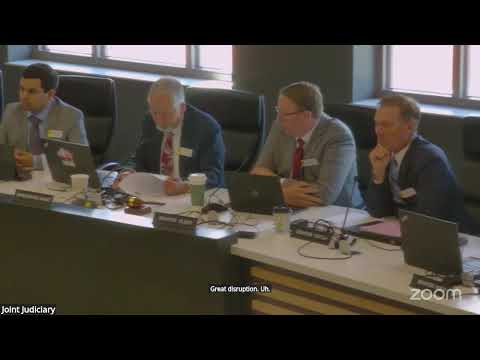
A bill draft presented to the Joint Judiciary Committee would let the Wyoming Department of Family Services (DFS) review its programs’ effectiveness and, in narrowly defined circumstances, share existing department data to connect families with services.
LSO staffer Mr. Fuller told the committee the draft (26LSO75) would authorize the DFS director to permit data sharing "notwithstanding any confidentiality requirements specified in statute" but only for three purposes: referrals, provision of services, and participation in bona fide research (later amended in committee language toward program evaluation and data analysis). The draft also contains conforming amendments to confidentiality provisions across several statutes and requires DFS rulemaking and a report to the committee by Oct. 1, 2026, describing what data were shared and what safeguards were used.
"We are not interested in going out and getting new data," Corinne Schmidt, director of the Wyoming Department of Family Services, said in testimony. She described the change as a targeted way to let communities and service providers help families earlier: "When we get those calls ... most of the time they do not rise to a level of our intervention. We say thank you. We ask the reporter, can you make some connections?" Under the draft she said the director would screen requests, require written data-use agreements and take the proposal through rulemaking so the public may comment.
Committee members pressed the department on several points. Representative Kelly asked whether DFS has the staff and funds to expand outreach; Schmidt said some services, such as adult protective services, are underfunded and that the department had sought supplemental general funds in the prior session. Senator Kolb and others repeatedly sought statutory guarantees that shared data would be de‑identified and not exposed by future agency leadership changes; Schmidt said the department relies on an internal data governance committee and proposed rulemaking and data-use agreements as public safeguards, and said the agency would be willing to remove the "bona fide research" phrasing and substitute language such as "data analysis and program evaluation." Representative Broughton and others asked how referrals would work in practice; Schmidt gave an example where a school or pastor who is a mandatory reporter could be asked to reach out to a family without revealing DFS was the source.
The committee adopted a conceptual amendment replacing "bona fide research" with program evaluation/data analysis. Another proposed amendment to require that data shared be "not individually identifiable" failed on a committee voice vote. The chair suggested the bill be refined and returned in Cheyenne; the committee agreed to carry the draft forward for more work rather than taking final action that day.
The bill draft references multiple statutes for conforming changes and creates a reporting requirement; any future sharing would be subject to the director’s approval, a public rulemaking process and the data‑use agreements described in testimony. The director said DFS could remove the research component if that eases legislative concerns but emphasized the referrals piece as the department’s priority.
Next procedural step: the committee agreed to continue work on the draft and return the bill for further refinements in Cheyenne.