Lifetime Citizen Portal Access — AI Briefings, Alerts & Unlimited Follows
Summit counselors report nearly 95% of Class of 2025 pursuing higher education
Loading...
Summary
Counseling staff told the board that almost 95% of Summit High School’s Class of 2025 reported plans to pursue higher education, with most enrolling in four‑year out‑of‑state colleges; presenters highlighted rising application volume and increased international matriculations.
Summit Public School District counselors told the school board that nearly 95% of the Class of 2025 reported plans to pursue higher education, and that the majority will attend four‑year colleges outside New Jersey.
"Almost just under 95% are pursuing higher education," Laura Kaplan, the district’s director of school counseling, told the board during a presentation of graduation outcomes. Kaplan and district counseling staff said a large share of those students—about 96% of those pursuing higher education—are headed to four‑year institutions, with a smaller share choosing two‑year colleges and career education paths.
The counselors presented several breakdowns used to explain the headline figure. They said a small number of graduates planned gap years (three to five, updated over the summer), two enlisted in the Army, several pursued career‑education programs (automotive, culinary arts and a district 18–21 program), and five graduates’ post‑graduation plans were listed as unknown at the time of graduation.
Counseling staff also described geographic trends: roughly 80% of four‑year matriculants are leaving New Jersey, with the Mid‑Atlantic and neighboring states the most common destinations. Presenters cited private out‑of‑state and public out‑of‑state institutions as the primary destinations and named Rutgers and The College of New Jersey as competitive in‑state options that, in the presenters’ view, are generally less generous with merit aid.
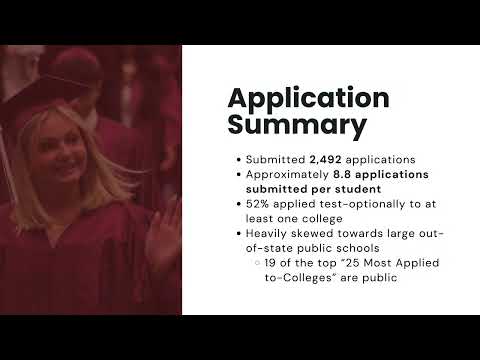
Data on application activity showed rising volume: counselor staff reported 2,492 total applications submitted by the class—about 200 more than the prior year—and noted that features of the Common Application and direct‑admit tools have contributed to higher application counts. Presenters added that about 52% of applications were to test‑optional programs and that some selective colleges are returning to score requirements, a shift counselors said families should monitor.
The staff highlighted early decision (ED) as a strategic pathway for many students: roughly a third of applicants used ED, which counselors said can improve admission odds and help colleges meet institutional goals and supports for targeted student populations. Presenters also called attention to a rise in international matriculations: 10 students from the graduating class are headed abroad to institutions in Canada, the U.K., Spain, the Netherlands, Switzerland and Israel.
A board member asked why it matters for counselors to serve on college advisory boards. The presenter responded that such boards allow counselors to bring local context to admissions offices and to return with information that helps students identify appropriate, affordable matches.
The presentation concluded with counseling staff noting ongoing efforts to support families in interpreting financial aid awards and to connect students with programs that reduce cost barriers. The board had no immediate action on the presentation; it was received as informational.