Troy council ends older brownfield plan and approves Somerset West redevelopment plan with reimbursement agreement
Loading...
Summary
The Troy City Council on Sept. 29 voted unanimously to terminate Brownfield Redevelopment Plan No. 5 (Pavilions of Troy) and adopt Brownfield Redevelopment Plan No. 12 for Forbes Frankel Troy Ventures LLC, a project officials say will convert a long‑vacant former Kmart site into mixed‑use space and create a local revolving brownfield fund.
Troy City Council voted unanimously Sept. 29 to terminate the long‑standing Pavilions of Troy brownfield plan and to adopt a new brownfield redevelopment plan for the Somerset West project, a redevelopment of the former Kmart headquarters on West Big Beaver Road.
Developer Nate Forbes told the council the project has already required substantial demolition and remediation work on a property vacant for about 20 years. “We took a major risk in working kind of out of the ordinary by demolishing a 20 year vacant obsolescence building,” Forbes said, calling the planned development a long‑term investment in the corridor.
Attorney Richard Barr of the Hahniglin firm summarized the financial mechanics for the council. He said the site’s current taxable value is about $7,200,000 and that the private, taxable portion of the planned development is projected to increase that value to about $125,000,000. Barr said reimbursable brownfield costs are approximately $9,200,000 and that capture of tax increment is projected to begin in 2027 and be completed between 2031 and 2032. He also estimated a local revolving brownfield fund of roughly $7,800,000 would be available after reimbursements are finished to support future eligible projects under the state brownfield law (Act 381).
Council members sought and received detail about the composition of reimbursable costs. Barr identified primary categories and approximate amounts: asbestos abatement about $2,300,000; demolition line items totaling about $4,700,000; environmental work roughly $250,000; plus interest and other customary reimbursement costs that together reach the stated reimbursable total.
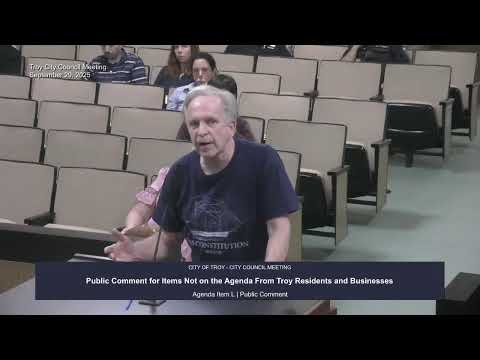
A resident who spoke during the public hearing questioned whether road work and other municipal actions were prioritizing the developer’s interests and asked whether taxpayers would be reimbursing Forbes for costs. Mayor Baker and staff clarified that the roadway work behind the Somerset area was funded through Oakland County programs and state allocations, not Troy general‑fund dollars, and that under brownfield law the tax increment captured to reimburse the developer represents new tax revenue generated by the development rather than existing tax levies.
Before voting, City Attorney Bloom urged the council to record separate votes for (a) termination of the prior plan and (b) adoption of the new plan and reimbursement agreement; both measures were then approved. Miss Dixon recorded unanimous yes votes from Mayor Baker and each council member; the motions carried.
Councilors who spoke in favor framed the plan as a tool to spur redevelopment of a blighted, contaminated property and to capture long‑term tax revenue and development benefits for the city. Several councilors noted that Michigan Medicine (University of Michigan) will occupy a tax‑exempt portion of the site, and that the $125 million projection refers to the private, taxable portion of the development.
The council’s approvals formalize the termination of Plan No. 5 and adoption of Plan No. 12 and authorize the associated reimbursement agreement for Forbes Frankel Troy Ventures LLC covering the parcels listed in the agenda packet.