Get Full Government Meeting Transcripts, Videos, & Alerts Forever!
Get email alerts on the Facilities Consolidation topic
No spam. Unsubscribe anytime.
Corvallis SD 509J superintendent lays out consolidation pathway after facilities review
Summary
Superintendent Ryan Asse presented an LRFP update showing long-term enrollment declines and underused facilities, proposed a public engagement schedule and said he will present a recommended consolidation proposal Sept. 11 with board deliberation planned through November.
Superintendent Ryan Asse told the Corvallis School District board during a retreat on Aug. 13 that staff work on the district's long-range facilities plan shows substantial underutilization across district buildings and that he will bring a consolidation proposal to the board on Sept. 11 for public review and comment.
The presentation from Director of Operations Kim Patton, based on an eight-member Long Range Facilities Planning Committee and consultant analysis, showed the district has substantially more building capacity than enrolled students. Patton reported the committee's finding that enrollment declined by about 1,100 students over the past ten years and that districtwide elementary capacity was calculated at 3,233 students while the district's 2024'25 enrollment was presented at roughly 2,300 (about 72% utilization). Patton also said most buildings fall in the green or yellow range on the facility condition index and cited an example that Bessie Coleman's current replacement cost was estimated at $54,000,000 versus about $39,000,000 spent when it was built.
Why it matters: district staff and the LRFP committee concluded the combination of declining enrollment and available capacity creates fiscal pressure and reduces the breadth of programs the district can sustainably offer. Asse urged the board to weigh both the facilities data and the community's concerns as staff draft the next steps.
Asse described the proposed public timeline and decision process: he said he would present a recommended proposal at the Sept. 11 board meeting, hold multiple superintendent chats and listening sessions through October, and bring a final proposal for deliberation and possible action in late October and Nov. 13 to enable planning for the next school year. "So on September 11 at the board meeting, I will be bringing forward a proposal or several proposals for you to consider," he told board members.
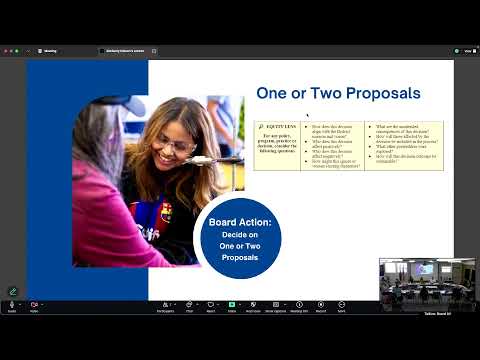
Board members debated whether staff should present a single recommended course of action (which some said would reduce community uncertainty and be more trauma‑informed for affected schools) or multiple scenarios for comparison. Several trustees asked staff to include the evaluation criteria and to present the baseline ("do nothing") impact so the public could compare tradeoffs.
The LRFP committee's formal conclusions shared with the board included: projected underutilization (with a 2028'29 projection of 59% elementary utilization in one slide), that facilities are generally in good/fair condition and should be maintained, a recommendation to retain district properties where feasible to preserve future flexibility, continued community engagement and collaboration with the City of Corvallis on housing and growth, and a review of intra‑district boundaries to support enrollment trends and equity.
What the district will do next: Ryan Asse will bring a recommendation to the Sept. 11 packet that includes the rationale and alternatives considered; staff plan multiple community listening sessions and superintendent chats before final board deliberation. The board did not take a consolidation vote at the retreat. The meeting later approved routine consolidated action items by motion (moved by Samuel Adrobo, seconded by Judah Largent) and adjourned at 2:47 p.m.
Sources and caveats: the article relies on presentations and remarks delivered at the Aug. 13 retreat by district staff. The Oregon Department of Education (ODE) requirement that districts complete long-range facility planning every seven to 10 years was cited in the presentation; numbers and projections were presented by district staff and the LRFP committee and will be updated when the district publishes the final committee report and subsequent board packets.