Get Full Government Meeting Transcripts, Videos, & Alerts Forever!
Get email alerts on the Land Use Rezoning topic
No spam. Unsubscribe anytime.
Snellville council approves rezoning for 108-townhome project on Tree Lane
Summary
After a contested public hearing with residents and institutional neighbors raising traffic, school-capacity and blasting concerns, the Snellville mayor and council voted 6-0 on Sept. 8, 2025 to rezone 15.0137 acres at 1719 Scenic Highway from BG to RTH for a 108-unit townhome project (RZ25-05) with staff conditions and variances.
SNELLVILLE, Ga. — The Snellville mayor and city council voted unanimously on Sept. 8 to approve a rezoning request (RZ25-05) that clears the way for a 108-unit townhome development on a 15.0137-acre site at 1719 Scenic Highway (Tree Lane).
Planning staff presented the application and recommended approval of the rezoning and most variances, with conditions including a mandatory homeowners association, a 25-foot undisturbed buffer where the project abuts existing homes, architectural variation across front facades, restrictions on signage and adult-entertainment uses, requirements tied to the Georgia Blasting Standards Act, and a prohibition on converting garages to additional living space.
The applicant, represented by attorney Jack Wilson, described the proposal as a downzoning from the site’s current Business General (BG) classification to Townhouse Residential (RTH). "This is a down zoning," Wilson said, noting the plan provides roughly seven acres of green space (about 46% of the site), multiple pocket parks, and additional off-site parking. He told council the residential use would generate substantially fewer vehicle trips than many BG uses and highlighted required stormwater controls that, he said, will reduce peak flows compared with the site’s current unmanaged condition.
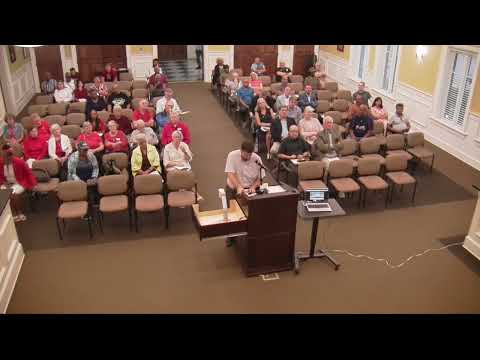
Opposition at the public hearing came from neighbors and nearby institutions who raised a range of concerns. Drew Williams, executive director of the adjacent Sheridan at Eastside senior-living community, said he represents about 250 senior residents with an average age of about 84 and warned the single egress onto Tree Lane could exacerbate congestion near Piedmont Eastside Hospital and compromise safety for seniors and emergency access. "I represent about 250 senior residents. Their average age is about 84 years old," Williams said.
Residents also cited stormwater and erosion issues on the parcel, school-capacity concerns for the Brookwood cluster, and potential damage from blasting. Theresa Burke, an adjacent homeowner, described nearby stream and watershed problems and asked for a larger buffer than the 25 feet proposed. Several speakers urged the council to follow the planning commission’s prior recommendation to deny the rezoning.
During the hearing Kat Hardrick alleged that the developer had made campaign contributions to council members; she named specific amounts and recipients. In rebuttal, the applicant’s counsel said the donations were "entirely lawful and proper," disclosed under state law, and that there was no legal basis to require recusal.
Mayor Bender and other council members repeatedly noted legal limits on the grounds for denying rezoning requests. "We can't say no to something just because of traffic," the mayor said, noting courts overturn zoning denials based solely on traffic or school-impact arguments. Council discussion focused on balancing the neighborhood’s concerns with the city’s limited legal standards for denial and the range of uses permitted under the existing BG zoning. Several council members emphasized that the BG classification allows many commercial uses by right that could generate equal or greater traffic.
Council also discussed engineering and public-safety checks: Gwinnett County Fire reviewed and deemed the proposed hammerhead turnaround acceptable for emergency access, while staff recommended the conventional cul-de-sac as a precedent. The final approval incorporated staff conditions and clarified that substantial deviations from the rezoning site plan would require further mayor-and-council approval.
The motion to approve RZ25-05 (referencing Ordinance 2025-17 and the Sept. 8 staff recommendations on variances and conditions) passed on a 6-0 vote.
Next steps: the applicant must comply with the listed conditions (HOA formation, buffers, blasting notification and compliance, design/architectural treatments, and stormwater engineering). Substantial plan changes will return to the mayor and council for review.