Get Full Government Meeting Transcripts, Videos, & Alerts Forever!
Get email alerts on the Cec Scenarios topic
No spam. Unsubscribe anytime.
CEC scenarios show large potential gas demand declines; commission and utilities flag rate and reliability tradeoffs
Summary
CEC staff presented demand‑reduction scenarios and a total‑customer rate tool showing wide possible rate outcomes if revenue requirements grow while demand falls. Utilities and advocates debated how forecasts should inform local planning, reliability standards and cost-recovery rules.
San Francisco — At the CPUC workshop, California Energy Commission analysts presented updated demand scenarios and a rate‑impact modeling tool intended to help policymakers and utilities understand how electrification pathways could affect natural‑gas rates and system planning.
Nicholas Janish of the CEC summarized the agency’s three gas demand products (the IPR/IGRA annual work, long‑term scenarios to 2050, and a seasonal peak‑day forecast for reliability). He described the Additional Achievable Fuel Substitution (AAFS) modeling framework used to aggregate program impacts, codes-and-standards, and potential zero‑emission appliance adoption. Janish said the scenarios diverge most on existing‑building replacement assumptions and observed that, in CEC modeling, several mid‑ to high‑adoption scenarios reduce gas consumption roughly 30–40% by 2040 compared to baseline assumptions.
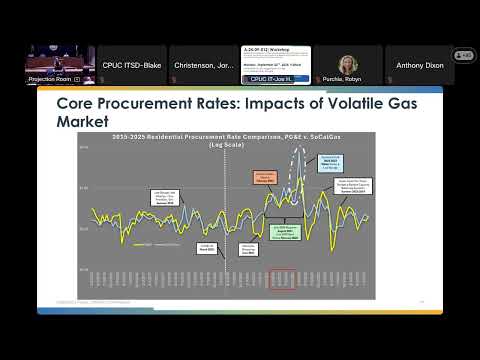
Anthony Dixon followed with the CEC’s total‑customer‑rate analysis. He explained the two pieces of a customer’s bill — a transportation (revenue‑requirement based) component and a commodity/ procurement component — and how the CEC’s tool combines a commodity‑price forecast with a transportation‑rate model (class allocations were held constant in the demonstration). Using 2023 adopted forecast inputs and several AAFS demand cases, Dixon showed scenarios in which modeled residential total customer rates for some hubs could rise materially by 2050 if the revenue requirement continues to grow while demand declines.
Panelists pushed back on modeling assumptions and stressed practical distinctions. SoCalGas and PG&E presenters said distribution capital and many replacement projects are driven by condition, safety and localized customer requests — not only long‑term forecasts — and that peak‑day (1‑in‑10 or 1‑in‑35/90) planning remains central to reliability. Nate Taylor (SoCalGas) cited Decision 23-12-003 as a constraint against preemptively retiring capacity before feasible alternatives exist.
Advocates and intervenors asked the CEC to publish underlying assumptions and scenario details to enable replication and scrutiny; CEC staff said refinements are ongoing and that seasonal/peak‑day work will be advanced later in the year. Regulators and stakeholders agreed that scenario outputs should be treated as planning inputs rather than adopted forecasts — useful for testing sensitivities and identifying where policy or program changes would have the greatest impacts.
Next steps: CEC will continue peak‑day and long‑term scenario work; CPUC staff will make workshop materials available and collect comments. Utilities said they will use these inputs, along with field data and localized forecasts, to inform design standards and potential pilot selection.