Get Full Government Meeting Transcripts, Videos, & Alerts Forever!
Get email alerts on the Npa Workshop Overview topic
No spam. Unsubscribe anytime.
CPUC workshop gathers utilities, agencies and advocates to plan nonpipeline alternatives and SB 12-21 pilots
Summary
At a CPUC workshop in San Francisco, state agencies, utilities and advocacy groups discussed how demand forecasts, CEC scenario modeling and local pilot design affect efforts to replace pipeline projects with nonpipeline alternatives (NPAs). Debate focused on cost recovery, community consent thresholds and near-term pilot design.
San Francisco — The California Public Utilities Commission convened a full-day workshop to advance planning and pilot design for nonpipeline alternatives (NPAs) to traditional gas infrastructure work, bringing together state agencies, investor-owned utilities, community-choice aggregators, environmental groups and local governments.
Commissioner Douglas opened the session and noted Senate Bill 12-21’s deadlines: “Senate bill 12 21 requires the CPUC to designate priority neighborhood decarbonization zones by 01/01/2026 and to establish voluntary pilot programs for those zones by 01/01/2026,” a statutory timeline that participants repeatedly cited as a driver of urgency.
Presentations covered three related threads: how demand forecasts influence long-term infrastructure needs and rates; how the California Energy Commission models long-range electrification and what that implies for gas consumption; and practical pilot designs, including service-line electrification and larger neighborhood “zonal” projects.
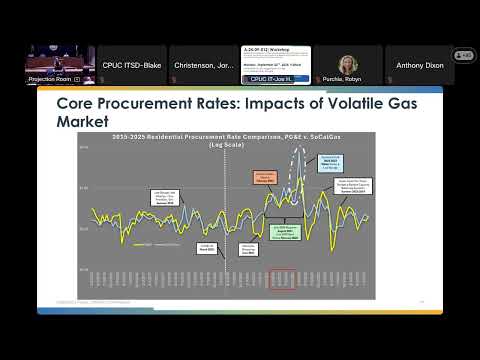
CEC staff summarized recent scenario work showing deep possible reductions in gas consumption under aggressive appliance-adoption assumptions. Nicholas Janish of the Energy Commission described AAFS/AAEE scenario families and said the most important and uncertain variable is replacement-on-burnout of existing gas appliances in existing buildings. Anthony Dixon, also of the CEC, presented a forecasting tool that combines a commodity-price model with utility transportation-rate modeling and showed wide differences in modeled total-customer rates across demand scenarios — bookends that illustrate how lower gas throughput can raise unit rates absent commensurate changes in revenue requirements.
Utility planners said forecasts matter differently for different decisions. SoCalGas and PG&E engineers explained that local distribution investments are normally driven by asset condition, safety and specific customer requests; system-level forecasts are more relevant to backbone capacity standards, storage and peak-day planning. Nate Taylor of SoCalGas stressed that annual demand declines can coincide with continued high peak-day needs, a distinction that affects whether and how the companies can safely downsize infrastructure.
Advocates and intervenors urged the commission to adopt clear threshold rules now. Presenters from NRDC, Tern and Earthjustice offered a staged benefit‑cost assessment for NPAs, suggested what data utilities should provide (risk metrics, electric headroom, customer density), and pressed for an explicit cost-recovery approach so projects and pilots can move forward.
Utilities and local governments described ongoing pilot work. PG&E described two programs (an Alternative Energy Program and a Zonal Equity Electrification Program) that have produced early experience and outreach results; PG&E staff reported a roughly 25% sign‑up rate to date in early outreach for some offerings. The City of Long Beach reported planning to test microzone pilots with local electricity partners to evaluate feasibility in disadvantaged communities.
A central recurring question was who pays and how: whether behind‑the‑meter electrification costs should be treated as regulatory assets (with short depreciation periods) charged to gas ratepayers, funded from electric rates, or subsidized with state/local grant dollars. Advocates pointed to New York and Colorado examples where regulators have used regulatory‑asset treatment or performance incentives to align utility incentives with NPA deployment. Other participants emphasized that pilot design must account for workforce, installation quality and long-term maintenance (including refrigerant management for heat pumps) to ensure claimed emissions and cost benefits materialize.
Workshop participants left with several concrete near‑term steps: CPUC and staff will post workshop materials and a staff summary and accept written comments; CEC staff said it will proceed with seasonal/peak‑day work this fall and continue refining long‑term scenarios; utilities will continue piloting and provide more data to staff for program design. CPUC staff and attorneys signaled additional guidance and rulemaking to follow as pilots and data mature.
The commission closed the workshop saying staff would compile the record and return with next steps and proposals for how to operationalize pilot selection, data needs and cost‑recovery rules. The debate is expected to continue through filings and public comments, with SB 12-21’s timelines a persistent scheduling anchor.