Get Full Government Meeting Transcripts, Videos, & Alerts Forever!
Get email alerts on the Licensing Fees topic
No spam. Unsubscribe anytime.
DCC advisory committee hears widespread calls to overhaul cannabis licensing fees as small growers plead for relief
Summary
The Department of Cannabis Control’s Cannabis Advisory Committee heard extensive member and public testimony urging a reassessment of license fees, citing steep wholesale price declines, METRC/tagging costs, and proposals for square-foot or revenue-based tiers, rebates or payment plans.
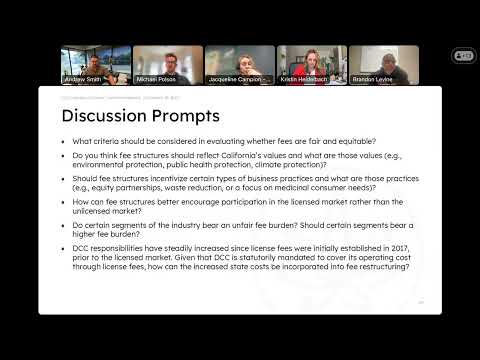
The Department of Cannabis Control’s Cannabis Advisory Committee spent the meeting’s central segment evaluating whether California’s licensing fees remain appropriate given market changes and unequal burdens across the supply chain. Deputy Director Deborah Olsen reiterated that DCC operations are funded entirely by licensing fees and that excise tax revenue does not support department operations.
Members and dozens of public commenters urged the DCC to commission economic and efficiency studies before any fee changes. One CAC member referenced Proposition 64’s findings about supporting a diverse-scale economy and said fee design should avoid incentivizing monopolies while protecting small and legacy cultivators. Several members proposed options including absolute fee reductions for cultivators, rebates tied to revenue, indexing fees to market prices, and incentives for sustainability practices.
Small cultivators and industry groups told the committee that wholesale prices for outdoor flower have dropped by about 80% since the fee schedule was set in 2017, forcing many small operators to operate at losses or exit the market. Craig Johnson of Alpenglow Farms said his renewal fee should be “about $960” rather than roughly $4,800 under current market conditions. Ross Gordon of Origins Council presented spreadsheet analysis showing small farmers now pay about 3% or more of annual revenue to licensing fees compared with roughly 2% for larger cultivators; the analysis also found smaller cultivators can pay 4–10 times more, proportionally, than larger operators.
Contract and tagging costs were a persistent focus. CAC members confirmed METRC-related costs are covered by license fees; multiple speakers called for more transparency and oversight of the METRC contract. One commenter stated METRC appears to be paid $28,400,000 per year for monitoring activity and asked whether that contract can be renegotiated or run more efficiently. Members suggested exploring options such as batching/tagging changes tied to SB 622 implementation and other process reforms to reduce licensee costs.
Industry participants also urged the DCC to consider practical changes to fee design. Suggestions included per-square-foot fee calculation instead of fixed ranges, payment plans spread across the revenue cycle to smooth cash flow, tiering processors and nurseries by revenue, and allowing small cultivators to incrementally increase canopy rather than forcing new licenses. Several speakers warned that revenue-based fees raise auditing and enforcement burdens and that square-foot measures can be cleaner administratively.
CAC members repeatedly said they want a data-driven approach before voting or making formal recommendations. Member and public requests included a staff-provided, itemized expense and revenue report, the original economist findings that informed the 2017 fee schedule, and updated market analyses. The committee closed agenda item number 5 without taking a motion and signaled that staff would return with more specifics in early 2025.
The CAC did not adopt any fee changes at this meeting. Members and Deputy Director Jacqueline Campion acknowledged Bagley-Keene constraints that prevent making motions on topics not on the agenda, and recommended placing the proposal for further study and public hearings on an upcoming 2025 agenda if permitted.