Get Full Government Meeting Transcripts, Videos, & Alerts Forever!
Get email alerts on the Gaming Central Monitoring topic
No spam. Unsubscribe anytime.
Committee adopts gaming central‑monitoring bill with vendor‑cost and conflict‑of‑interest limits
Summary
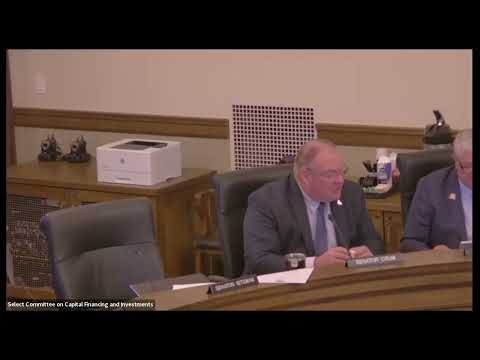
The Select Committee adopted 26 LSO 0 124, requiring the Wyoming Gaming Commission to establish centralized monitoring systems for gaming categories; the committee amended the draft to allow separate platforms for different game types, require operators to bear costs, extend the compliance deadline to July 1, 2027, and bar conflicts of interest for chosen vendors.
The Select Committee on Capital Financing & Investments voted to adopt a bill draft that requires the Wyoming Gaming Commission to establish centralized monitoring systems for gaming activity subject to commission jurisdiction, but members amended the original language in several substantive ways before adoption.
LSO presented draft 0.57‑01 (26 LSO 0 124), which originally described a single centralized system into which all gaming machines and online sports wagering systems must be connected for continuous monitoring, auditing and, in some cases, remote disabling.
Committee members and the gaming commission's director, Nick Laramendi, debated technical feasibility across game categories (online sports wagering, skill‑based amusement, and pari‑mutuel wagering). Laramendi said differing platform architectures make a single universal technology unlikely and recommended allowing separate platforms that report to a central point.
Key amendments the committee adopted:
• Pluralized "system" to "systems" so the statute permits separate monitoring platforms for different gaming categories while maintaining centralized oversight. Representative Nicholas offered the amendment and the committee approved it.
• Struck a specific paragraph that mandated linking each machine "at a reasonable and affordable cost," leaving precise cost‑sharing rules to commission rulemaking.
• Required that any costs above the commission's standard budget be borne by the applicable operators or vendors, not by state general revenues; Senator Crum led that measure and it passed.
• Extended the implementation deadline to July 1, 2027, to allow time for RFPs and vendor responses and to return to the Legislature with concrete cost estimates if necessary.
• Added a conflict‑of‑interest bar modeled on Nebraska that prohibits the successful vendor from holding ownership interests in entities licensed under the act, to avoid the appearance of impropriety.
• Removed online sports wagering from the mandatory linkage portion of the bill (the committee noted practical and privacy limits for personal handheld devices), though online sports wagering remains within commission oversight through other rules.
The committee adopted the draft as amended on roll call. LSO staff and the gaming commission will draft conforming language and rulemaking direction to implement the committee’s policy choices. Committee members stressed the next steps should include RFPs and clearer vendor costing so legislators can assess fiscal impacts ahead of subsequent sessions.