Get Full Government Meeting Transcripts, Videos, & Alerts Forever!
Get email alerts on the Wyoming Gold Act topic
No spam. Unsubscribe anytime.
Treasurer's office readies $10 million specie purchase; Casper storage option discussed
Summary
State treasurer's office told the Select Committee it is on track to meet the statute requiring a $10 million purchase of specie by Jan. 1, 2026, with options to store the metals in New York or at a Casper facility; Wyoming storage is marginally more expensive but may yield ancillary public benefits, officials said.
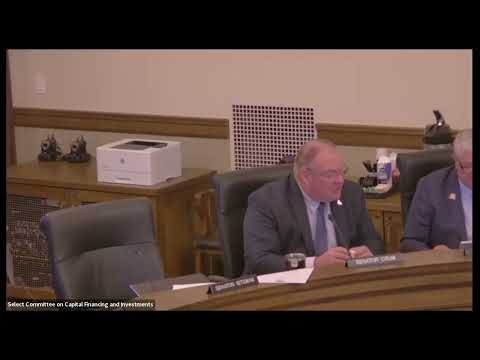
The state treasurer’s office told the Select Committee on Capital Financing & Investments that it is readying to comply with the Wyoming Gold Act statutory mandate to acquire specie (gold/silver) and expects to execute a $10,000,000 purchase as directed by law.
Norman LeBlanc, interim chief investment officer for the treasurer’s office, said due diligence has been conducted in three areas — acquisition, transportation and storage — and that the office has contacted major institutional counterparties for acquisition. "We are ready to make final decisions and get in a position to make those purchases by 01/01/2026 as per the statute," LeBlanc told the committee.
LeBlanc described two storage options under consideration: storage with a high‑credit New York provider (where the state has a long relationship) and a Wyoming‑based facility in Casper. He said the commission’s research showed Wyoming storage is "marginally more expensive" over a five‑year horizon — approximately $13,000 more in aggregate when considering transport and storage — but added that on‑state storage may carry ancillary public‑purpose benefits tied to physical proximity and development in an opportunity zone.
Transportation costs were estimated as a one‑time fee of about $9,650 if the state moves the metals to Wyoming; no transportation cost was quoted if the metal remains in New York. LeBlanc said the treasurer’s office expects to make a single purchase and single transport to achieve cost efficiency.
Committee members asked whether the Casper facility is operational and whether it had passed audits; LeBlanc confirmed the facility currently stores precious metals for other entities, has passed audits, and is undergoing security enhancements to be completed by year‑end.
Several members urged the treasurer’s office to assess liquidity tradeoffs: LeBlanc noted that keeping the metals in New York provides greater liquidity because New York connections to Comex make secondary market activity easier, while Casper can still offer some liquidity through counterparties who will trade against Wyoming‑held metal.
The treasurer’s office emphasized that the $10 million purchase is a statutory obligation rather than discretionary policy and that, while gold may be a sound tactical position, the mandate directs the office to buy and store the specified amount by the statutory date.