Get Full Government Meeting Transcripts, Videos, & Alerts Forever!
Get email alerts on the Special Education topic
No spam. Unsubscribe anytime.
DIAB presses PGCPS, lawmakers for special-education funding, facility fixes and accessibility
Summary
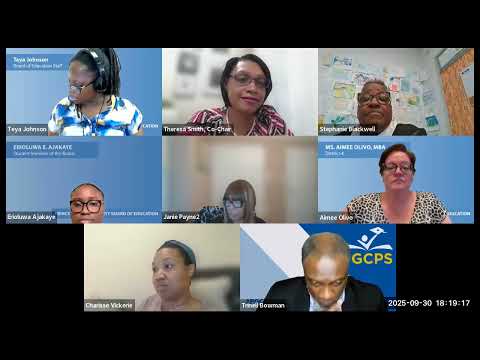
At its Sept. 30 meeting, the Disability Issues Advisory Board urged Prince George's County Public Schools and state lawmakers to prioritize special-education funding, repairs to aging facilities and student-safety investments after a legislative-day briefing; members also pressed for visual-alert pilots for deaf students and for data on accommodation timelines.
Vice Chair Smith said the advisory board’s recommendations drew a positive response from district leadership following a Sept. 19 legislative-day briefing, and she urged lawmakers to turn that attention into funding and policy changes for students with disabilities. "It sounds like we do have a commitment, from administration to to improve some of the items that we, that we are recommending," Vice Chair Smith said.
The board’s vice chair summarized four priorities PGCPS leaders presented to state officials: special education funding and staffing incentives; construction and facility modernization; targeted programs for multilingual learners; and safety and security upgrades. She said the district remains under state oversight, has submitted corrective actions to the court of education and reported progress on vacancies: "From what I understand, [teacher vacancies] has been reduced by 50%." The board highlighted that about 45 percent of district students are identified as multilingual learners, a central reason the board is pushing for sustained, targeted instructional funding and stronger recruitment pipelines.
Members pressed administrators and each other on capital funding mechanics. Board member Vickery explained that the IAC scoring formula — which she said includes a school’s enrollment and surrounding-area enrollment — constrains which schools qualify for state-supported replacement or refurbishment, and members called for more flexible funding to address deferred maintenance and CTE lab needs. Vice Chair Smith relayed that district leaders told the group about a large backlog of deferred maintenance despite 17 major capital projects completed since earlier efforts began.
Accessibility and safety drew sustained attention. Members described gaps in visual alerting for deaf or hard-of-hearing students after an incident in which a student could not hear an alert; Vickery asked the facilities subcommittee to study visual-alert systems and to weigh potential medical triggers for students with photosensitive conditions. "In a past life I worked with those who were hearing impaired...our main language was ASL...So it is a strobing light," Vickery said as an example of an alert design to consider. The district also discussed limited CIP funding that would currently cover security cameras at roughly six to 10 schools, and members noted rising on-campus Narcan use and the need for broader health and addiction education.
The group also raised staff-side accommodation concerns. Members reiterated that the team processing reasonable-accommodation requests is understaffed, producing delays for PGCPS employees seeking assistive technology or other workplace accommodations. Board member Patrick said she will file a Freedom of Information Act request to collect county data on timelines for accommodation responses to track whether the situation improves.
The board agreed to convene subcommittees (policy/governance, facilities/new construction, and hiring/employment) ahead of the next full DIAB meeting to prepare legislative asks and to follow up on outstanding data requests. Chair Stephanie Blackwell closed the meeting by announcing the next DIAB meeting on Oct. 28, 2025.
The advisory board recorded no formal roll-call vote in the transcript on agenda adoption or minutes approvals; those items were adopted or approved by consensus during the meeting.