Get Full Government Meeting Transcripts, Videos, & Alerts Forever!
Get email alerts on the Public Art Ordinance topic
No spam. Unsubscribe anytime.
Grass Valley Planning Commission approves draft public art ordinance
Summary
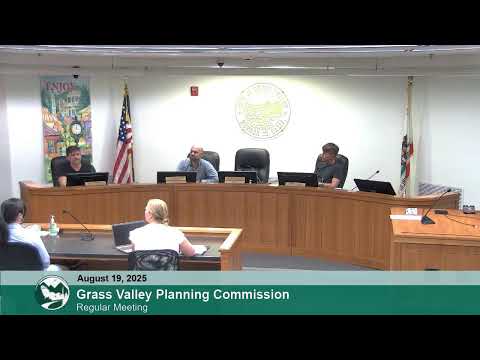
On Aug. 19, 2025, the Grass Valley Planning Commission voted unanimously to approve a draft ordinance setting standards and a review process for public art—including murals, sculptures and mosaics—clarifying when installations count as signage and which approvals are required.
GRASS VALLEY, Calif. — The Grass Valley Planning Commission on Tuesday voted to approve a draft ordinance that would establish standards and a review process for public art installations within city limits, including murals, sculptures and mosaics.
Staff member Amy told commissioners the measure expands the municipal code’s mural rules to cover a broader range of visual art and mostly mirrors the current mural-review process. "The draft ordinance provides a process for applicants to propose visual art such as sculpture or mosaics," Amy said, adding that the ordinance requires a finding that an artwork’s colors, placement and size be "visually compatible with the surrounding character area" and that the artwork "will serve to enhance the aesthetics of the city."
Under the proposal, visual art on private property in commercial or other nonresidential zones would be approved by the Planning Commission; visual art proposed on public property would be decided by the City Council with a Planning Commission recommendation. Staff said work within the historic district would also require a recommendation from the historical society.
Commissioners asked about text in artwork and whether words in a mural would count as signage. Staff confirmed that text incorporated into visual art is counted toward a site’s sign-area allowance under the city’s current mural standard, limiting large text-dominant murals unless applicants pursue a sign exemption or variance. Staff also emphasized the ordinance’s definition excludes works intended to advertise or identify a business or product; intentions judged to be advertising would be subject to sign rules.
A commissioner moved to approve the draft ordinance to establish standards for public art installations in the city; the motion was seconded and the commission voted unanimously. The meeting record shows three members were present for the vote and the motion passed "as described by staff."
Amy said the ordinance is expected to be forwarded to the City Council for consideration in September. The commission also discussed how unusually large or text-based pieces could be handled through existing sign-exemption or variance processes and noted that special findings could be made on a case-by-case basis.
The Planning Commission took no additional formal action on other items during the meeting and adjourned after routine announcements and scheduling.