Get Full Government Meeting Transcripts, Videos, & Alerts Forever!
Get email alerts on the Resilience Planning topic
No spam. Unsubscribe anytime.
UVA team presents RAFT resilience scorecard to Carroll County; residents flag infrastructure and service gaps
Summary
University of Virginia researchers presented a resilience scorecard for Carroll County and outlined a 12-month implementation process driven by community workshops. Residents cited communication, broadband, water infrastructure, healthcare access and housing as primary gaps.
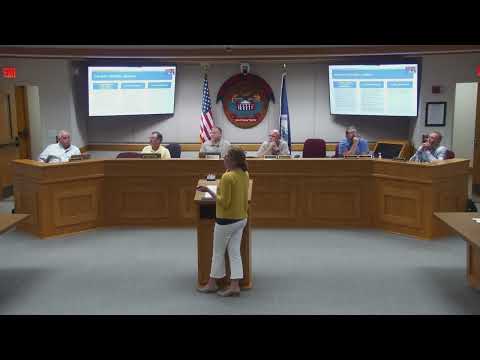
University of Virginia researchers briefed the Carroll County Board of Supervisors on their Resilience, Adaptation and Feasibility Tool (RAFT) on Sept. 3, presenting a data-driven scorecard and next steps for local workshops and a yearlong implementation phase.
Dr. Amanda Hall of the University of Virginia and Ian Baxter, presenting virtually, said the RAFT is a multi-university partnership that assesses local resilience across five categories: leadership and collaboration, risk assessment and emergency preparedness, infrastructure resilience, planning and policy, and community engagement. Baxter described the score as a percentage of a 108-point total and said communities score as "low," "moderate" or "high" based on thresholds the team defined.
"It's the resilience adaptation and feasibility tool," Baxter said, explaining the methodology and noting most localities the team has reviewed fall in the low-to-moderate range. The presenters said Carroll County shows strengths in emergency coordination and certain leadership areas but has room for improvement in planning, funding and community outreach.
Hall summarized two nights of community conversations, saying the RAFT team received 40 RSVPs and 22 attendees across sessions. She said residents identified the county's strong sense of community, natural resources and local schools as assets. Key needs raised included improved emergency resource coordination, better cell and Wi-Fi service, countywide water infrastructure improvements, flash-flood mitigation, increased access to specialized healthcare, affordable housing and living-wage employment.
Presenters recommended forming an implementation team of community members, hosting workshops in September to prioritize actions and then executing selected projects over a 12-month implementation period supported by university and regional partners. Hall announced upcoming public sessions and workshops and encouraged broader community participation.
Board members pressed presenters about the low planning score—one supervisor noted a 7 out of 20 on planning-for-resilience—and asked how zoning and ordinances factor into resilience. Baxter and Hall said zoning and subdivision ordinances can limit development in flood-prone areas and that many resilience actions in existing documents are not currently funded. They recommended identifying funding opportunities and bringing trainings and technical assistance locally to build capacity.
The RAFT presentation set a public schedule for additional community input and a September action workshop that will prioritize specific projects for the county to pursue during the implementation year.