Get Full Government Meeting Transcripts, Videos, & Alerts Forever!
Get email alerts on the Land Use Development topic
No spam. Unsubscribe anytime.
Fairview zoning board denies conditional‑use permit for Green Springs "rural retreat"
Summary
After hours of public comment and technical objections, the Fairview Board of Zoning Appeals voted 5–0 to deny a conditional‑use permit for a 577‑acre ‘rural retreat’ proposed by Green Springs Prop LLC, finding the applicant failed to meet the burden of proof and left key traffic, parking and environmental questions unanswered.
The Fairview Board of Zoning Appeals voted 5–0 on Sept. 10 to deny a conditional‑use permit sought by Green Springs Prop LLC and project owner Walker Lund for a proposed private “rural retreat” at 5185 Old Harding Road.
The board adopted written findings concluding the applicant had not met the burden of proof, could not demonstrate compliance with applicable Fairview ordinances, and that the proposed uses did not align with the city’s 2040 long‑range plan. Board members also said the record lacked sufficient information to make a reasonable decision on traffic and parking impacts.
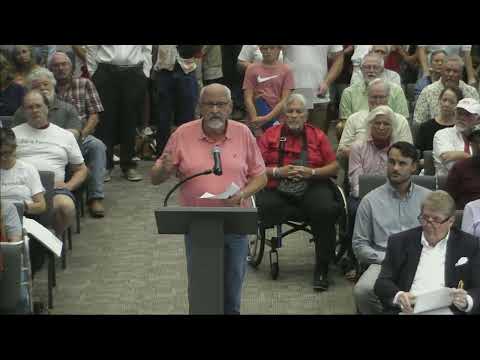
At the public hearing, neighbors, engineers and local advocates urged denial. Civil engineer Chris King told the board he calculated a large increase in runoff from paving: “By paving just the road, it's gonna produce an extra 1,100,000 gallons of water” that would flow onto downstream properties and into the South Harpeth River. Harpeth Conservancy founder Dori Bowles emphasized water‑quality and floodplain management concerns and urged the board to require robust stormwater and stream‑buffer conditions if the use were considered.
Opponents framed the proposal as incompatible with the neighborhood’s rural character. Resident Steven Lester, a fifth‑generation property owner, said the valley was a multigenerational sanctuary and urged the board to “reject this proposal, protect this land.” Dozens of other residents cited flood history, wildlife and farm operations that they said would be harmed by a driving course, rifle range, amphitheater and associated infrastructure.
Applicant Walker Lund and his representative presented the plan as a conservation‑oriented private members' facility that would preserve large areas of open space. Brian Wright, representing the applicant, described an illustrated plan with clustered cottages, agricultural areas, trails and a roughly three‑mile driving course, saying the submission left more than 94% of the site as open space. Lund told the board the club would pay property taxes and argued the traffic impact would be small — he provided a ballpark figure of “27 to 58 visits per day” for members, staff and vendors — and he demonstrated a decibel reader to address sound concerns.
City staff and several attorneys and engineers representing neighbors countered that the conditional‑use application must satisfy the zoning code and that critical technical materials — including a detailed site plan, a complete traffic study and thorough engineered analyses of grading and stormwater — were missing or inadequate. Attorney Jim Murphy told the board the panel’s role was to determine compliance with the zoning ordinance and that the applicant had not met that burden. Other counsel and expert witnesses highlighted the multiplicity of proposed commercial‑style activities (guest lodging, amphitheater, restaurant, driving course, shooting facilities) that they said are not permitted in the R‑20 residential district.
Board discussion focused on the limited, quasi‑judicial criteria the appeals board must apply: whether the applicant proved compliance with the conditional‑use standards, whether the project’s uses equated to commercial activities, and whether the board had enough factual evidence to assess traffic, parking and safety. Several commissioners said they found the concept attractive but concluded it did not fit the city’s designation for the site under the 2040 plan and that the record left unresolved engineering and traffic questions.
When the resolution to approve the conditional use was called, the roll call vote was Mitchell — Nay; Dwyer — Nay; Batson — Nay; Hill — Nay; Anderson — Nay. After the motion to approve failed, the board moved to adopt findings of fact and conclusions of law documenting the denial.
The vote concludes the Board of Zoning Appeals’ decision on the conditional‑use application; the board adopted its written findings on the record and adjourned. The resolution read into the record listed the requested amenities — agriculture areas, nature trails, vehicle garage, amphitheater, clubhouse, sporting clay course, rifle range, approximately three‑mile driving course, an emergency services site and up to 50 detached units — but the board found that the applicant had not proven those uses met the code requirements.
No timetable for any subsequent filings or appeals was stated at the meeting. The board’s denial and the adopted findings will be part of the official record of the Board of Zoning Appeals.