Get Full Government Meeting Transcripts, Videos, & Alerts Forever!
Get email alerts on the Municipal Budgeting topic
No spam. Unsubscribe anytime.
Sequim finance director presents proposed 2026 rates and fees; public hearing set for November
Summary
Finance Director Sue Hagener outlined Sequim's proposed 2026 rates and fees, saying most fees will move to full cost recovery, utility GFCs will rise by 3%, sewer rates by 4.5% and water by 5.5%, and a public hearing is scheduled for November.
Sue Hagener, Sequim's finance director, presented the city’s proposed rates and fees for 2026 and said the annual ordinance will set next year’s charges and ensure the city recovers the costs of services.
Hagener said the budget-development policy generally requires fees for services that provide a private benefit to recover full costs — direct and indirect, including capital and overhead — while limited, intentional subsidies may be documented and periodically reviewed. "General taxes should not generally subsidize a private benefit or limited interest," she said.
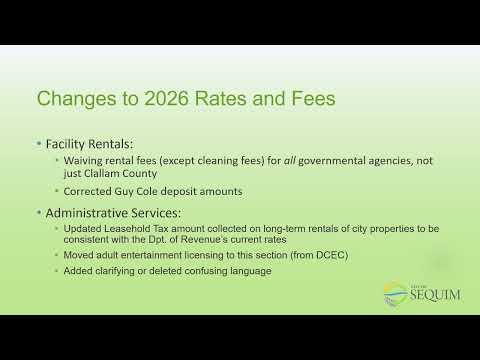
City staff reviewed departmental fees and recommended several changes across code chapter 3.68. For facility rentals, Hagener said the draft waives rental fees for government agencies but retains cleaning charges. Administrative changes include updating the leasehold tax collected on long-term city property rentals to 12.84% to match the Washington State Department of Revenue and moving adult-entertainment licensing into administrative services to align oversight.
In community and economic development, the package adds new appeal types, requires upfront collection of third-party hearing-examiner fees in some cases, increases the hourly rate used to price staff time for outreach and customer-service work, and adds certain new land-use permit types. Public-works changes clarify recovery of third-party costs, add an hourly development-review fee, and remove free hours for electric-vehicle charging in favor of a per-kilowatt charge to help recover station maintenance costs.
On utilities, Hagener said Sequim will increase water and sewer general facility charges by the 3% inflationary factor used in the draft. Per council resolutions referenced by staff, sewer rates in the proposed schedule rise by 4.5% and water rates by 5.5% for 2026. Using the city’s illustrative chart for a single-family household consuming 500 cubic feet per month, Hagener said the 2026 bills would be roughly $36.96 for water and $67.81 for sewer, for a combined monthly bill of about $104.76. She said the long-term, council-approved changes average about 2.9% per year for water and 1.3% per year for sewer, with a combined average annual increase of about $1.68 (roughly 1.6%).
Hagener noted the city is continuing its low-income utility discount and has simplified the application by removing the net-asset requirement; she also said the city aligned program features to be consistent with the local public utility district’s approach. Hagener contrasted Sequim’s approach to larger, less-frequent increases elsewhere, saying Port Townsend adopted a 17% increase in 2025 and plans 2026 increases (sewer +13%, stormwater +10%), while the PUD plans an 8% increase for 2026; she said Port Angeles’ 2026 plans were still unknown.
Next steps: Hagener asked council members to submit questions by email and said the city will hold a public hearing in November to consider adoption of the proposed 2026 rates and fees.