Get Full Government Meeting Transcripts, Videos, & Alerts Forever!
Get email alerts on the Municipal Budget topic
No spam. Unsubscribe anytime.
Sequim finance director presents $51.6 million proposed 2026 budget, including about $17.3 million in capital projects
Summary
Finance Director Sue Hagener presented the Sequim City Manager's proposed 2026 budget totaling $51.6 million, citing a roughly $17.3 million capital improvement plan, a proposed 1% property tax levy increase and modest staffing additions; council will review the proposal in fall public hearings.
Finance Director Sue Hagener on Sept. 12 presented the Sequim City Manager's proposed 2026 budget to the mayor and city council, laying out a $51.6 million package of appropriations that includes roughly $17.3 million for capital projects and a proposed 1% increase in the property tax levy.
"This budget reflects the city's dedication to sound financial stewardship and prudent fiscal management," Hagener told the council during a detailed, single-speaker presentation of the digital budget book and timeline for adoption.
Why it matters: The proposed budget sets service and capital priorities for Sequim, funds routine operations in the general fund and several enterprise funds, and establishes the amounts council will consider when it certifies the levy and adopts the budget later this year.
Top-line numbers and fund rules Hagener said the total appropriations across all funds are $51,600,000 and reminded council that the body approves the budget at the fund level. The general fund is the city's primary governmental fund, with proposed expenditures of about $13.7 million. Hagener reported a modest general-fund surplus of roughly $14,000 in the 2026 projection and estimated an ending reserve of about $4 million, which she said is slightly above policy maximums.
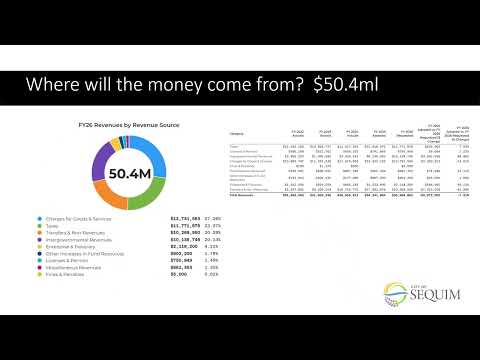
Revenues and major drivers Most revenue categories rise from the prior-year budget, Hagener said: taxes are projected up by about $855,000 (roughly 8%), intergovernmental grant revenues are up by about $4 million, and charges for goods and services decline in part because developer contributions to capital projects are lower than in the prior budget cycle. She highlighted sales tax mechanics, noting the city receives a small share of the regional sales-tax rate and that $1,000 in local retail sales yields about $11 for the city.
Spending pressures and transfers Overall expenditures rise modestly, with general-fund expenses up about $385,000 (3%). Salaries and benefits account for much of that change; Hagener cited a $257,000 increase tied to three collective bargaining contracts, step increases and cost-of-living adjustments for nonrepresented staff. The budget also includes $1.2 million in transfers out of the general fund, including $200,000 for civic center debt service, $230,000 to an equipment reserve and $700,000 for street operations.
Operations funds and capital plan Hagener described individual operational funds: street operations revenues are projected up about 13%, supporting two added seasonal positions and other costs; water operations reflect an assumed 5.5% rate increase approved earlier by council, producing an estimated 8% revenue increase and about a 6% rise in water expenses. The 2026 capital improvement program is presented at approximately $17.3 million, covering parks, capital facilities, streets, water and multi-divisional projects; Hagener said the CIP is about $7 million smaller than the 2025 CIP and that project-level detail appears in the departmental pages of the digital budget book.
Staffing and workforce changes Total city FTEs in the 2026 budget are 101.6, a net increase of about 1.08 FTE from the 2025 budget. Hagener detailed specific adjustments: removal of 0.38 FTE tied to a temporary retirement crossover, conversion of 0.2 FTE to part time, addition of 0.66 FTE to fund two seasonal public-works positions, and creation of a 1.0 FTE public-works asset analyst position to manage asset data and Cartograph software implementation. Total salaries and benefits across funds are estimated at about $13.2 million (roughly a 5% increase).
Decisions and next steps Hagener listed the specific items that will require formal council action: the allowed 1% property tax levy increase, final adoption of rates and fees, approval of proposed capital projects under the CIP and final approval of the 2026 budget. She reminded council of the schedule of optional one-on-one meetings with staff in October, upcoming public hearings in November, the Nov. 30 deadline to submit the property-tax levy to the county and the need to adopt a budget by Dec. 31 to permit government operations on Jan. 1. She encouraged council members to request printed budget books, ask for follow-up meetings and submit questions to her by email.
What the presentation did not include Hagener's presentation was an overview; the document contains department-level details, project descriptions and funding notes for council review. There was no formal council vote during the session.
The council is expected to take up the proposed budget through scheduled hearings and deliberations over the fall and to act before the statutory levy and adoption deadlines.