Get Full Government Meeting Transcripts, Videos, & Alerts Forever!
Get email alerts on the Land Use And Nuisance Codes topic
No spam. Unsubscribe anytime.
Committee defers vote on ‘natural lawn’ ordinance after questions on setbacks, signage and neighborhood impact
Summary
Committee members debated BO2025-995, which would reduce setbacks for intentional natural landscaping and require registration; Metro Water Services supported the amendment but members asked for examples and signage. The committee voted to defer the ordinance for one meeting (8–0).
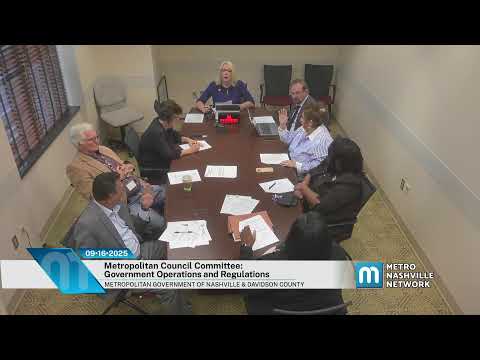
The Government Operations & Regulations committee considered BO2025-995, an ordinance that would amend multiple Metropolitan Code sections to allow and regulate intentional natural landscaping on private property by changing setback and registration rules. Committee members debated an amendment that would limit certain vegetation height and require NDOT traffic-engineer sign-off for visibility concerns.
Mike Jamieson of Metro Water Services described the bill’s three aims: renaming and clarifying the existing 'properties in a natural state' program, shrinking an existing 15-foot setback to a smaller buffer modeled on other cities (Jamieson cited Knoxville’s 36-inch/3-foot buffer), and allowing certain metro-managed recreation and greenway areas to participate. Jamieson said the amendment would require NDOT sign-off for sight-line safety and that the department supports the amendment. He told the committee, “We only get about 3 or 4 applications a year.”
Committee members pressed on enforcement and neighbor notification. Several members raised concerns that unregistered properties could be mistaken for high weeds, that allowing natural landscaping could depress neighbor property values or invite pests, and that homeowners associations may have different rules. Jamieson said registration would be recorded with the Beautification Commission and visible in the hub system; he also said he was not aware of pest or rodent problems arising from approved intentional designs in the past two decades (citing input from horticultural staff).
Members also discussed visible markers for participating properties; Jamieson said signs had been used historically but are not currently required and he would check whether signage could be formalized. Given outstanding questions — including requests for photographic examples of registered properties and clarity on required signage — Member 2 moved to defer the bill for one meeting. The motion to defer was seconded and the committee voted 8–0 to defer BO2025-995 for one meeting.
The deferral leaves open follow-up items: committee members requested photos of existing approved installations, clarification on whether the code text should require signage or a public notice, and a detailed account of how the hub and Beautification Commission processes would appear to neighbors. The committee will revisit the ordinance in the next meeting cycle.