Get Full Government Meeting Transcripts, Videos, & Alerts Forever!
Get email alerts on the Student Assessments topic
No spam. Unsubscribe anytime.
Cannon Falls Area Schools board hears assessment, AP and CLEP results
Summary
District presenter Steven Serpz told the school board the district saw "almost a 5 point jump in reading" (about 4.8 points), a slight dip in math (about 51.1% to 50.9%), and reported AP/CLEP participation and credit-earning; board members discussed COVID-era cohort effects and declining ACT participation.
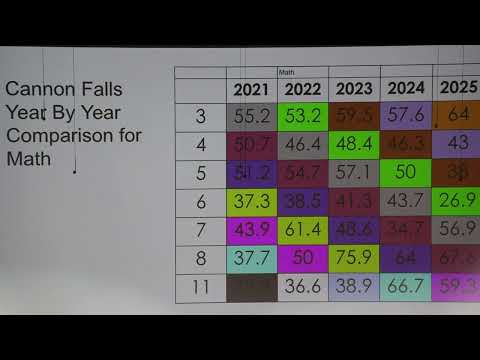
At its regular meeting, the Cannon Falls Area Schools board heard a presentation on 2025 assessment results and college-credit opportunities. Presenter Steven Serpz told the board the district "saw almost a 5 point jump in reading in terms of percent proficient," which he later described numerically as about a 4.8-point increase; math proficiency dipped slightly (from about 51.1% to 50.9%) and district science results "haven't been released yet" for local reporting.
Serpz reviewed participation in advanced coursework and testing. He said 69 students took one or more Advanced Placement exams this past spring, producing 82 exam scores; 54 of those 82 scores were 3 or higher (roughly 66%), and 46 individual students scored 3 or higher on at least one exam, likely earning some college credit. The district also offers College Level Examination Program (CLEP) tests on site and reported additional students earned college credit that way; Serpz said CLEP results are reported to students immediately and that district staff were still collecting some final records.
Board members asked whether pandemic-era learning disruptions could explain lower scores in certain cohorts. One member noted the current sixth-grade cohort was in first or second grade during the height of COVID-related disruption; Serpz acknowledged that cohort effects and fluctuating participation (including colleges' reduced ACT requirements in some years) complicate year-to-year comparisons. "A lot of them put a pause on using the ACT as an admission criteria," a board member said, noting that policy changes and lower student participation make trend interpretation more difficult.
The presentation included notes about testing cadence—reading assessments are not administered in ninth grade while math testing timing differs—so cohort comparison requires care. The district plans to provide families with single-page student reports this fall that will break results into strengths (for example, comprehension versus vocabulary) rather than an undifferentiated meet/does-not-meet label.
The board did not take formal action on the assessment presentation; members thanked Serpz and moved on to routine business.