
Council reopens fight over local campaign contribution limits after 4‑1 adoption
Get AI-powered insights, summaries, and transcripts
Subscribe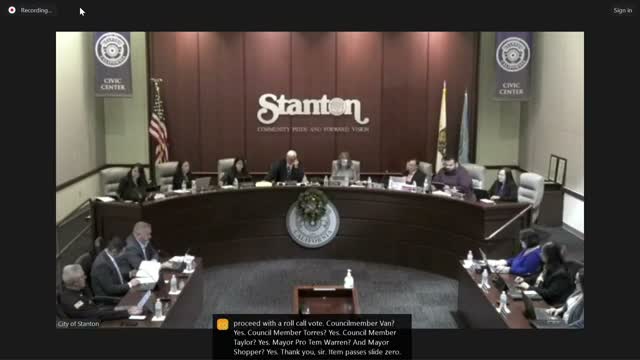
Summary
The Stanton City Council adopted Ordinance No. 1155 on local campaign contribution limits 4‑1 and then faced a successful motion to reconsider the ordinance amid debate over legal risk, timing and political motives. Members argued both for limiting big donors and for further review to avoid litigation.
The Stanton City Council voted 4‑1 on Dec. 10 to adopt Ordinance No. 1155, a local campaign contribution limits measure, then moved shortly afterward to reconsider that adoption, triggering a prolonged debate over whether the ordinance conflicts with state law.
The council initially approved the ordinance on second reading by a 4‑1 vote, with the mayor pro tem recorded as the lone no vote. Minutes later the mayor moved to reconsider the item, saying "Much of what was in that ordinance is contrary to state law, and it opens the city up for litigation." The city attorney confirmed a council member who voted with the majority may move reconsideration under the council's rules and advised that, if successful, the motion would return the ordinance to the stage of second‑reading consideration.
Supporters of the ordinance said local limits would reduce the influence of large donors and lower barriers for ordinary residents to run for office. "We don't need big interest money in our elections," one council member said, arguing the measure would make campaigns more accessible to community candidates and reduce special‑interest sway. Proponents pointed to experiences in other jurisdictions and described campaign finance reform as an ethics measure, not merely a legal one.
Opponents urged caution. The mayor and other council members said parts of the draft were potentially inconsistent with state law and could invite litigation, and they asked that the new, incoming council members have more time to review the proposal before it became binding. The city attorney noted staff had flagged deviations from state law in a prior report and cited historical litigation in this legal area.
The motion to reconsider passed, and council then debated substitute motions and alternatives, including delaying final action and returning the item for further study. During the exchange several council members traded sharp accusations about campaign spending in recent races and about a flyer distribution; some remarks were personal and led the mayor to call for the question to end debate.
The immediate procedural result of the Dec. 10 actions is that Ordinance No. 1155 was returned to the council for additional consideration as if the second reading had not yet occurred. Council members said next steps could include staff preparing a more detailed staff report comparing neighboring cities' approaches, a refreshed legal analysis, or re‑introduction of the ordinance at a future meeting.
The council did not adopt a final substitute ordinance during the Dec. 10 meeting; further action is expected at a later date once staff and council members have had additional time to review legal risks and neighboring practices.