Get Full Government Meeting Transcripts, Videos, & Alerts Forever!
Get email alerts on the Local Programs topic
No spam. Unsubscribe anytime.
Saint Paul Office of Financial Empowerment outlines College Bound growth, guaranteed-income pilots and ARPA-funded local ownership fund
Summary
The Office of Financial Empowerment told the Budget Committee it has enrolled more than 15,200 families in College Bound Saint Paul, reported $3.2 million in accumulated savings, described ongoing guaranteed-income pilots with over $3.0 million distributed, and detailed a $2.5 million ARPA local fund administered by Nexus Community Partners for worker and community ownership.
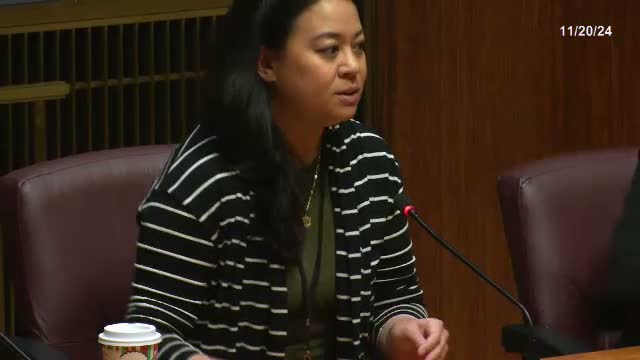
Ikram Koliso, director of the Office of Financial Empowerment, told the City of Saint Paul Budget Committee that College Bound Saint Paul has enrolled more than 15,200 participants and holds about $3.2 million in combined seed deposits, program bonuses and family savings. "Our mission is to advance economic democracy that shares prosperity with all Saint Paul residents," Koliso said as she outlined five result areas that guide the office's work.
Koliso said the program's average account balance is about $215 and the largest single account exceeds $12,000, and that College Bound is expanding into elementary schools through partnership with Saint Paul Public Schools to integrate deposits and college- and career-readiness prompts into personalized learning plans. She described family deposit days, Money Action Day and a community baby shower as outreach strategies and said families will be able to track deposits and bonuses through the program's savings portal.
The presentation also covered guaranteed-income pilots tied to College Bound. "As of November 15, over $3,000,000 were provided in direct cash payments and almost $800,000 in progressive deposits," Koliso said of the Boost pilot, which uses residency, income and College Bound participation as eligibility criteria and is being evaluated by the University of Michigan. She said participants will be offboarded through next summer as the 24‑month demonstration ends.
Koliso described a $2.5 million ARPA local fund, administered through Nexus Community Partners, split evenly between community ownership (acquiring or rehabilitating vacant commercial properties in HUD‑qualified census tracts) and worker ownership (technical assistance and capital awards to support cooperatives). She said Nexus is providing technical assistance and that "so far, the expenditure for the community ownership [program] is almost $100,000" and roughly $107,000 has been used for the worker-ownership side to deliver technical help while capital awards remain to be disbursed.
On the medical-debt reset initiative, Koliso said the city invested $1.1 million in ARPA to enable Undue Medical Debt (the nonprofit partner) to purchase eligible accounts for cancellation. "Saint Paul residents hold an estimated $110,000,000 in medical debt that can qualify for cancellation," she said, adding that the first batch resulted in about $4,000,000 of debt abolished for more than 32,000 residents. She described eligibility as dependent on residency, income (0–400% of the federal poverty guideline) and a medical-debt burden threshold of at least 5% of annual household income; letters notifying beneficiaries were being mailed.
Councilmembers asked for more detailed budget information separating city general-fund commitments from philanthropic and grant support; Koliso said most of OFE's program dollars come from external sources, that OFE has raised about $22 million toward a $35 million Fund for the Future to sustain College Bound, and offered to provide a consolidated budget breakout as a follow-up.
Next steps: OFE staff committed to supply the council with a program-level budget breakout and any additional evaluation materials from the guaranteed-income pilots and Undue Medical Debt.