Get Full Government Meeting Transcripts, Videos, & Alerts Forever!
Get email alerts on the Climate Funding topic
No spam. Unsubscribe anytime.
Residents urge council to keep franchise-fee climate investments; others push for levy reductions
Summary
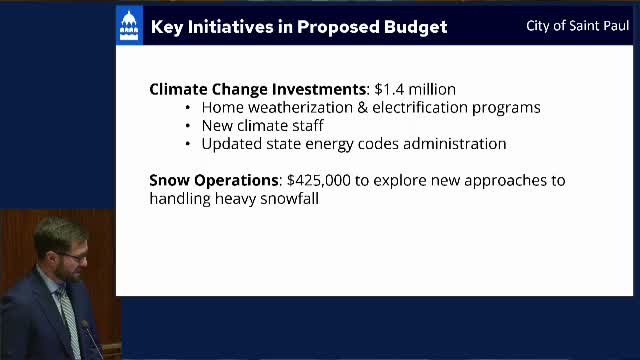
Dozens of residents urged the Saint Paul City Council to preserve franchise-fee funding for climate initiatives such as the Power of Home weatherization program and tree canopy restoration, while other speakers pushed for cuts to the proposed levy to ease homeowners' tax burdens.
At the truth-in-taxation public hearing, many speakers framed the core choice as a modest per-household tax relief versus ongoing climate investments funded by new franchise fees and other local revenue. Advocates from Isaiah, Unidos and Third Act Minnesota repeatedly asked the council to preserve or increase proposed climate funding and to invest in permanent weatherization programs.
"Use it," Joan Hahn of Isaiah said in reference to the franchise-fee revenue, summing up the plea from multiple speakers to dedicate those funds to weatherization and electrification. Speakers called for specific amounts: several members of Isaiah and allied groups requested $2,500,000 to $3,000,000 to expand the Power of Home program and to begin planning a citywide geothermal network.
Health and equity arguments were prominent. Dr. Amy Gilbert, a family practice physician, warned of indoor air pollution from gas stoves and linked fossil-gas removals to reduced asthma risk: "Children who live in homes with gas stoves have a risk of asthma symptoms 42 percent higher than children in homes without gas stoves," she said. Several speakers also argued that weatherization and insulation produce recurring savings for low-income households and reduce health and climate harms.
Opposing viewpoints emphasized immediate tax relief for homeowners and concerns that the city’s cumulative tax and fee burden is already high. Multiple homeowners and business owners described double-digit year-to-year property tax increases and urged the council to find cuts that would protect retirees and fixed-income residents. The council said it heard both sides and will weigh those trade-offs during budget deliberations ahead of the Dec. 11 adoption date.