Get Full Government Meeting Transcripts, Videos, & Alerts Forever!
Get email alerts on the Education Finance topic
No spam. Unsubscribe anytime.
After hours of public comment, Eagan council authorizes conduit bonds for Great Oaks Academy
Summary
Following broad public comment and Council questions about fiscal and equity impacts, the Eagan City Council authorized city‑issued conduit bonds to finance Great Oaks Academy's acquisition and renovation of a campus; bond counsel and underwriters explained repayment relies on charter lease aid and trustee arrangements, and the council voted 4–1.
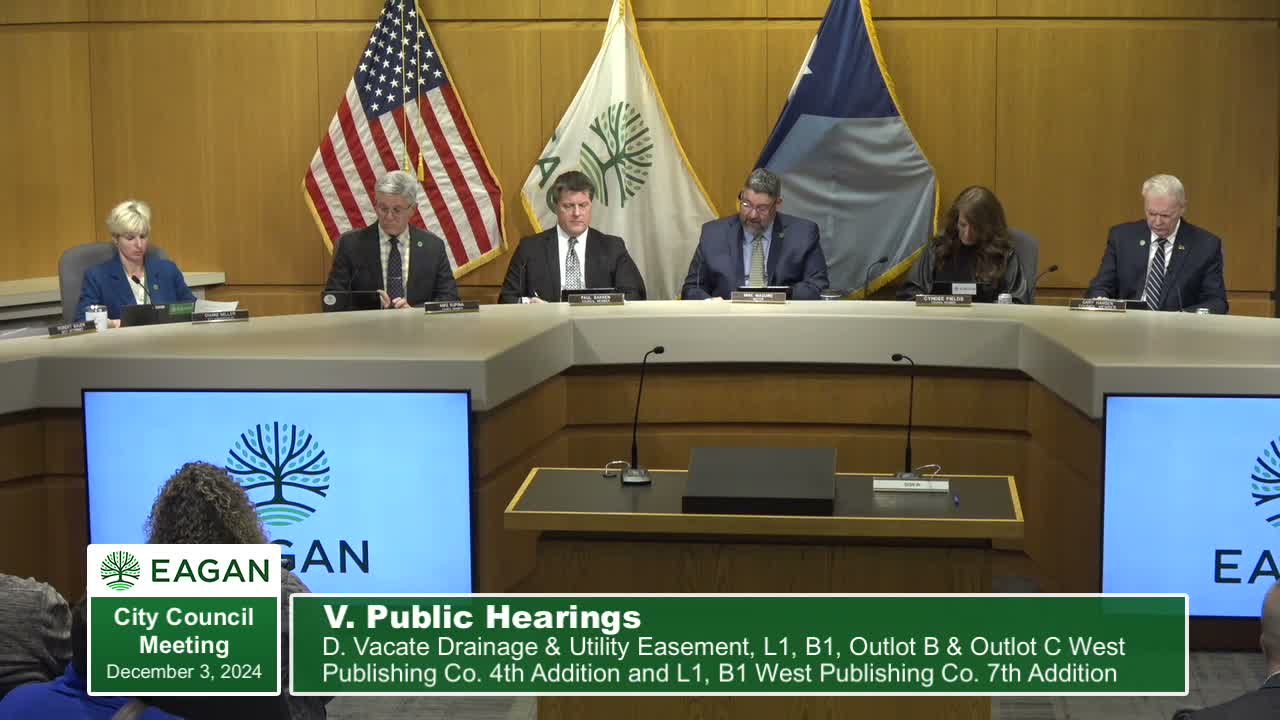
Eagan — After more than an hour of public testimony and detailed questioning from council members, the Eagan City Council on Dec. 3 voted to authorize the issuance of charter‑school lease revenue conduit bonds on behalf of Great Oaks Academy.
Bond counsel Jennifer Hansen (Dorsey & Whitney) told the council these conduit bonds are a common financing tool for nonprofits and that the bonds are limited obligations of the borrower, not liabilities of the city. "The resulting bonds are not a liability of the city," Hansen said, adding that the bonds would be issued on the borrower’s credit and, to her understanding, would be unrated.
Jay Ramotka of Piper Sandler, serving as underwriter, explained investors buy tax‑exempt municipal bonds and that the primary repayment source for a charter school conduit deal is state lease aid assigned to a trustee; he noted underwriters evaluate lease aid coverage versus projected debt service. Ramotka and other finance professionals explained that in a rare default investors generally look to the property serving as collateral and the trust account pledged to debt service.
The proposal generated sustained public comment from school district officials, public‑education advocates and neighbors. Corey Johnson, chair of the Rosemount‑Apple Valley‑Eagan school board, told the council the financing amounts to a public subsidy because the conduit mechanism provides tax‑exempt interest to investors and argued the council should pause to study possible fiscal and racial‑equity effects on neighborhood districts. "Using city access and resources to provide favorable interest rates and tax‑exempt payments is absolutely a subsidy that is being considered," Johnson said.
Supporters and Great Oaks representatives defended the school’s track record and said the bonds are a standard tool that enables charter schools to obtain lower borrowing costs necessary to acquire and renovate facilities. Great Oaks' executive director described the school's classical education model and its current enrollment in Farmington; board and community supporters noted fundraising and authorizer recognition.
Council members asked bond counsel and the underwriter detailed questions about state review, what happens in default, and whether the city’s own credit could be affected. Counsel explained state review (DEED/state approval as required by statute) and repeated that the city does not pledge taxing power. The underwriter said the school's purchase agreement for the campus carries a Feb. 11 expiration date, and that delaying the council decision could jeopardize the transaction and the school’s construction timeline.
After deliberation stressing both local benefit and community concern, Councilor Fields moved to approve a resolution authorizing the issuance and sale of charter school lease revenue bonds and related documents. The motion passed on a 4–1 vote: four council members voted in favor and one opposed.
Councilors directed staff to track related implementation steps and to respond to outstanding community questions; bond documentation will proceed to the marketplace and to state review.