Get Full Government Meeting Transcripts, Videos, & Alerts Forever!
Get email alerts on the Land Use Transmission Line topic
No spam. Unsubscribe anytime.
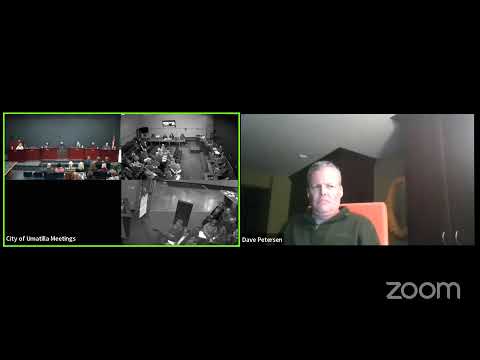
Umatilla council overturns planning commission, approves UEC transmission-line siting
Summary
After hours of public testimony and legal guidance, the Umatilla City Council granted UEC's appeal and overturned the planning commission's denial of a proposed transmission line, ruling the site meets the municipal code criterion for site suitability; the ruling may be appealed to the Land Use Board of Appeals.
The Umatilla City Council voted to grant an appeal by UEC and overturn a planning commission decision that had denied a permit for a proposed transmission line, concluding the site meets the city's code requirements for siting.
City attorney David Peterson told the council the appeal was "on a quite limited grounds" and that the sole contested question before them was whether the site is appropriate under Umatilla Municipal Code 10-12-1(a)(4). Peterson said council should focus on physical-site factors such as zoning, access and parcel configuration rather than broader policy concerns.
UEC's land-use attorney, Tom Brooks, and UEC representatives argued the application record includes detailed routing analyses showing alternative routes and quantitative comparisons. Brooks told council the packet contained a table with acres, road crossings, wetlands and easement counts and that those materials "were in front of the planning commission" and were "uncontested" in the record. UEC representatives also emphasized the site is designated for public facilities in the city's comprehensive plan and that state statutes limit placing transmission lines on EFU/farm land when urban or nonresource routes are available.
Residents who testified urged the council to deny the appeal. Denise Pratt, who said she bought her home for its "spectacular view of the Columbia River and the Washington Hillside," told the council she had been "blindsided about the plan to install these 135-foot power poles smack dab in our line of sight" and asked the council to reject the project. Jennifer Banks, identifying herself as a tribal member of the Confederated Tribes of the Colville, said "the Columbia River is my home, sacred to me" and urged consideration of impacts on future generations.
Brooks acknowledged residents' concerns but reminded council it was acting in a judicial capacity on the limited record and could not change code or make legislative policy in this proceeding. City staff had also noted a factual error in an earlier staff report regarding whether an alternative transmission route was inside the urban growth boundary; staff clarified that only one proposed route in the applicant's materials is fully inside the UGB.
Following deliberations, a council member moved to grant the appeal and overturn the planning commission's finding under UMC 10-12-1(a)(4). The motion received a second and carried. The transcript records the motion, a voice vote (ayes and opposed were called), and the outcome but does not include a roll-call tally of individual council votes.
The council's decision resolves the local land-use appeal in UEC's favor, but both staff and several council members noted the decision may be appealed to the Land Use Board of Appeals (LUBA). City staff also reminded council the city was at the statutory 120-day decision deadline, a timing constraint that influenced the process.
Next steps: the council's action approves the project at the local level; parties who participated in the hearing may appeal the local decision to LUBA, and the transcript indicates that either the applicant or community participants could pursue that option.