
Talent studies camping ordinance, hears regional shelter models and gaps in housing
Get AI-powered insights, summaries, and transcripts
Subscribe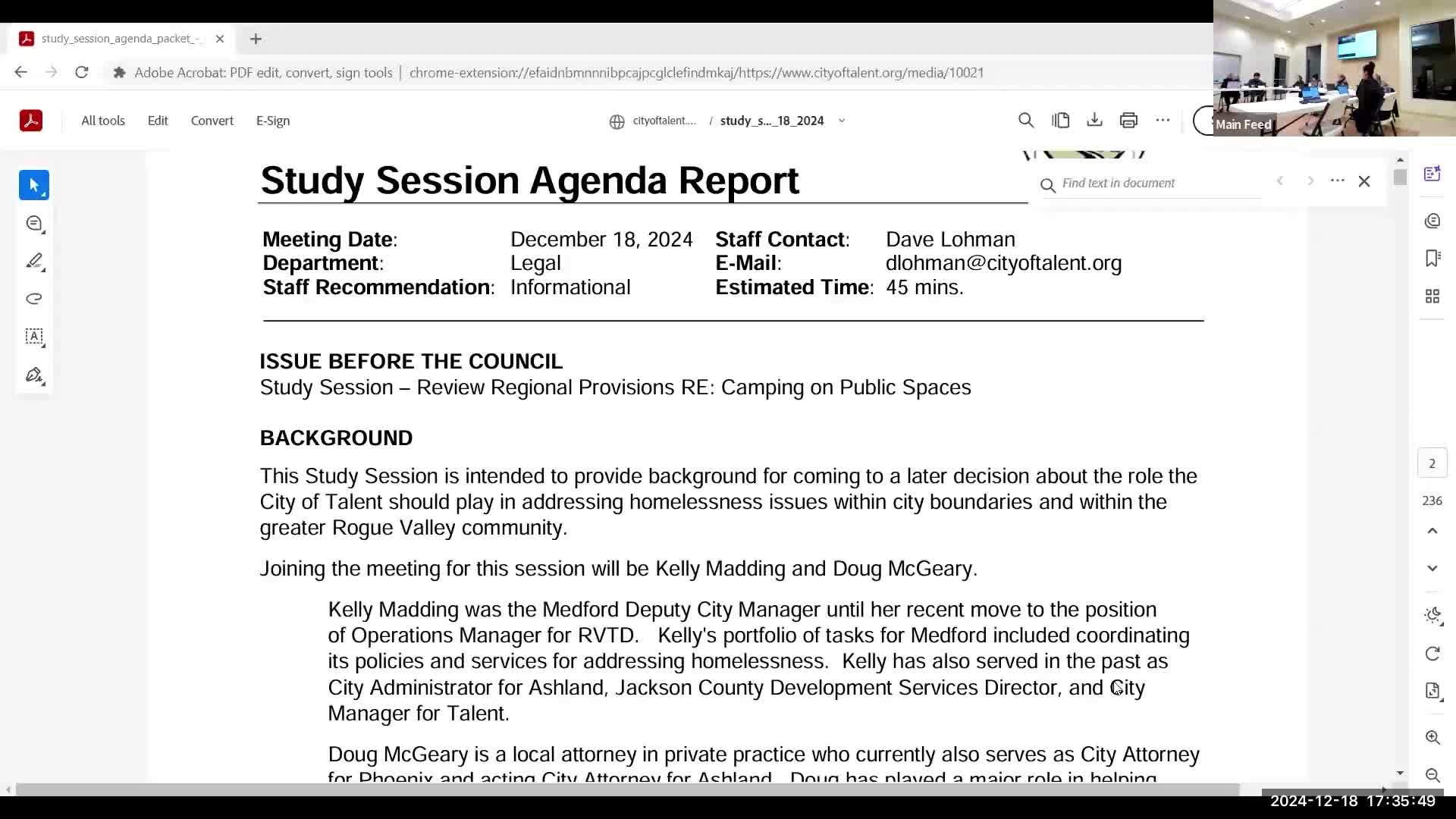
Summary
At a study session on camping on public spaces, Talent councilors heard regional practitioners describe Medford-area shelter models, outreach teams and data gaps, and discussed regional approaches and funding options; no ordinance vote occurred and staff recommended further study.
Talent’s council convened an informational study session on a proposed ordinance limiting camping on public spaces and heard detailed briefings from regional practitioners on shelter models, outreach and coordination.
Kelly Matting, introduced as formerly the Medford deputy city attorney and now an operations manager at RVTD, told the council about Medford’s pandemic-era responses and the range of low-barrier options that followed. She described a campground that began with about 25 people and grew to roughly 125, a congregate “Kelly Shelter” that she said housed about 50–60 people at times, and a larger facility called The Crossings that Rogue Retreat operates and that she said serves on the order of 150 people. “We just decided to do it,” Matting said, describing how local partners and nonprofits moved quickly to create space and services.
Matting said many of the programs allow pets and that the city runs severe-weather shelters when conditions are extreme. She said small jurisdictions sometimes purchase bed slots from regional providers — she said Central Point purchases two such beds — and estimated the full cost of a purchased bed slot at about $20,000–$22,000 per year to the purchasing municipality. Matting attributed program outcomes to Rogue Retreat’s internal reporting, saying the organization had earlier reported roughly 30% of some campground participants moved on and that certain program components have been described as producing about a 70% transition rate to temporary housing; she presented those as reported results rather than independently verified facts.
A second guest, identified in the meeting as Doug McGeary, described drafting coordinated camping ordinances for several nearby cities and urged multi-jurisdictional planning. He cautioned that ordinances are only one tool and urged officials to define statutory terms clearly (for example, what property cities are required to store when clearing camps) so courts do not later supply those definitions. “You have to define certain things in our ordinances because if you don’t define it, the courts will,” McGeary said.
Councilors pressed for operational detail. Asked what happens after hours, the official addressed as the police chief (unnamed in the transcript) said officers sometimes spend hours trying to locate an available shelter bed for a person and that after-hours options are limited. The chief said officers have at times exhausted available resources and that the police station is at capacity for storage, which complicates cleaning or removing camp property.
Several councilors and witnesses advocated for regional cooperation rather than each small city trying to build a full local system. Matting and others recommended sending representatives to the Jackson County continuum-of-care meetings and coordinating with Rogue Retreat and neighboring cities so that smaller jurisdictions can reserve bed slots and rely on regional outreach teams. The idea of a taxing or Greenway district to fund a regional livability team or “Greenway Rangers” was mentioned as one possible funding mechanism.
Speakers identified limitations in local data collection and gaps in permanent and supportive housing supply. Matting noted that while many dollars flowed into shelters (including ARPA and governor-declared emergency funds), downstream data on long-term housing outcomes remains incomplete and that the community needs more transitional and permanent supportive housing to move people out of shelters.
The council did not take any formal votes on an ordinance during the session. Staff characterized the night as a background study session and said more detailed follow-up meetings would be scheduled to examine legal constraints, data, and potential regional partnerships. The session closed with the presiding official thanking the guests and adjourning to the regular council meeting.
Ending: Staff and councilors signaled that further study sessions and staff work are planned before any ordinance is brought for a decision.