
Fenton aldermen approve nonbinding letter of intent with U.S. Army Corps to pursue Merrimack River design work
Get AI-powered insights, summaries, and transcripts
Subscribe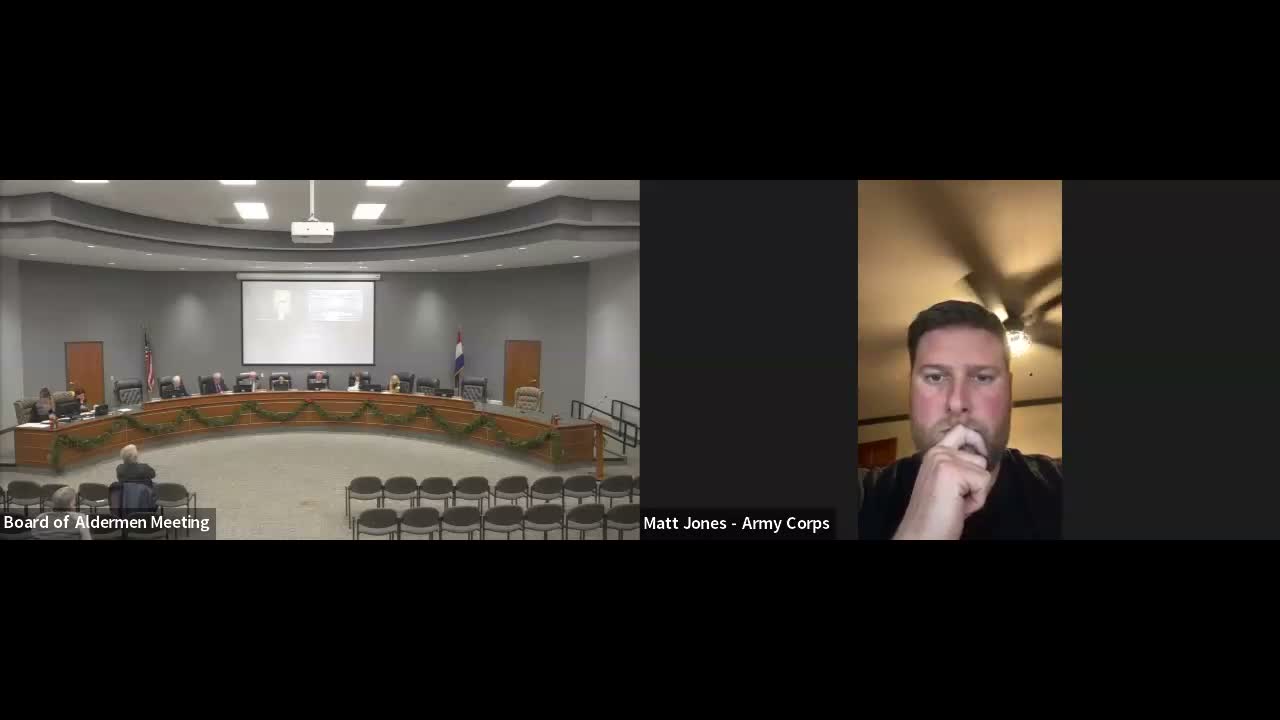
Summary
The Board of Aldermen voted unanimously Nov. 21 to authorize staff to sign a nonbinding financial-capability letter and letter of intent with the U.S. Army Corps of Engineers, allowing the Corps to advance a Merrimack River feasibility study into design; aldermen raised concerns about timing, budget impact and property-owner participation.
The Fenton Board of Aldermen voted unanimously on Nov. 21 to authorize city staff to sign a nonbinding financial-capability letter and a letter of intent with the U.S. Army Corps of Engineers, a step the Corps says is required to move its Merrimack River feasibility study into the preconstruction engineering and design (PED) phase.
Matt Johns of the U.S. Army Corps of Engineers told the board the documents are not a binding funding agreement but a formality headquarters requires. "This isn't legally binding," Johns said, adding the paperwork signals the city's interest so the Corps can include the study's recommendations in its final report. The Corps' recommendation is to pursue nonstructural floodproofing for 13 commercial structures and the elevation of one residential structure — 14 structures in total.
Why it matters: Corps staff said a federal–nonfederal cost share for design and construction would be about 65% federal and 35% nonfederal. The Corps' current first-cost estimate for the project is about $5.2 million; if all 14 properties participated, the city's nonfederal share would be roughly $1.8 million. Johns said communities can request design funds first (reducing upfront exposure), and specific site measures would be determined during PED.
Board members pressed the Corps on timing and fiscal impact. One alderman said the request came late in the city's budgeting cycle and expressed concern about committing funds before talking to absent colleagues and property owners. The alderman also noted only three property owners attended a recent meeting with Corps staff, raising questions about whether owner participation would be sufficient to meet the Corps' economic-justification tests. Johns responded that the Corps models feasibility scenarios assuming full participation but that the project’s ultimate viability depends on which and how many property owners opt in; if participation is too low, the Corps could terminate the project and return unspent local funds.
The board moved and seconded a resolution to allow staff to execute the financial-capability letter and letter of intent; the board recorded five "Aye" votes from members present and the motion carried. Johns told the board the Corps expects to submit its feasibility report to the division office within weeks; the division review could take a month or two, with design-phase agreements and funding requests several months after that if the division approves the report.
Next steps: If the division approves the final feasibility study, the Corps would draft a project partnership agreement for design and construction that the board would need to approve before the city would incur design or construction obligations. The board retains the option at any later step to decline entering the binding agreement required to spend local funds.