
Appeals court hears challenge to district courtabandonment finding in adoption case
Get AI-powered insights, summaries, and transcripts
Subscribe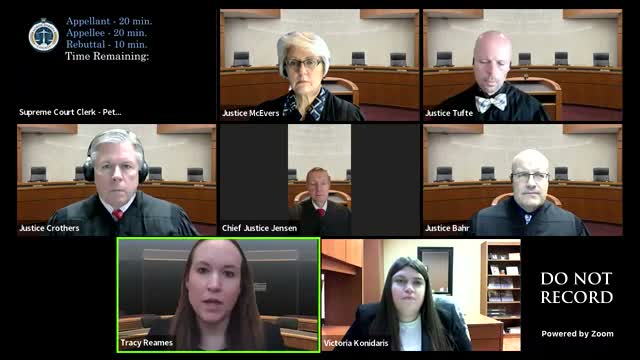
Summary
The North Coast Supreme Court heard oral arguments in an appeal over a district courtfinding that a father abandoned his child, enabling adoption without his consent. Appellant counsel said the father made repeated, if unsuccessful, attempts to contact the child; appellee counsel pointed to 629 days of no contact, more than $100,000 in arrears and lapses in insurance.
The North Coast Supreme Court heard competing arguments Friday in an appeal over whether a district court correctly found that a father abandoned his child, a finding that led to termination of parental rights and an adoption.
Appellant counsel Tracy Reams argued the district courterred, saying her client made repeated efforts to communicate with the child through texts and through an attorney and that he did not simply "disappear." Reams said the petition for adoption was filed in March 2024 and that the father filed a timely answer in April 2024; she described evidentiary hearings at the district court and urged the Supreme Court to reverse the abandonment finding and remand.
The appellee, represented by Victoria Kondaris, urged the justices to affirm. Kondaris recited the district courtfindings: the father had 629 days without contact or communication with his son, more than $100,000 in child-support arrears with a 14-month lapse in payments, and had not provided health insurance for the child since approximately 2018. Kondaris quoted the fathers trial testimony, saying he told the court "it wasn't worth it" and that "he was done trying," and argued those statements, along with prolonged noncontact, supported the abandonment finding.
Kondaris also told the court that even if the abandonment finding were erroneous, the district court had separately analyzed statutory grounds that would permit termination without a finding of abandonment, citing "section 14 15 0 6 1 b" as an alternative basis the district court relied on.
In rebuttal, Reams reiterated examples of attempts she said showed the father's intent to maintain a relationship: text messages in 2022 that went unanswered, an attorney retained in late 2022 who attempted to arrange FaceTime visits, and a February 2024 attempt by the father to visit the child at school. Reams said the father was advised to resolve a felony warrant first and that the record shows efforts that, she argued, undercut a finding of voluntary abandonment.
The bench asked several questions about precedent and the appropriate standard of review for factual findings. Counsel debated whether the cited precedents meaningfully distinguished the facts of this case and whether a trial courtchoice between two permissible views of the evidence is reversible under the clear-error standard.
The court took the case under advisement and adjourned. No decision was announced; the court stated it would reconvene on December 2.
Next steps: the Supreme Court will issue a written opinion after deliberation; the lower-court judgment remains in force until the court issues that opinion or issues other relief.