Get Full Government Meeting Transcripts, Videos, & Alerts Forever!
Get email alerts on the House Bill 24 Biomarker Testing topic
No spam. Unsubscribe anytime.
Insurers and small-business advocates tell Senate panel House Bill 24 could raise costs and strip medical-necessity discretion
Summary
Witnesses from the Ohio Association of Health Plans and the NFIB offered opponent testimony on House Bill 24, saying the bill would require coverage for biomarker testing, limit insurers' ability to apply medical-necessity criteria, risk higher test prices and premiums, and create inequities because many self-insured ERISA plans are exempt.
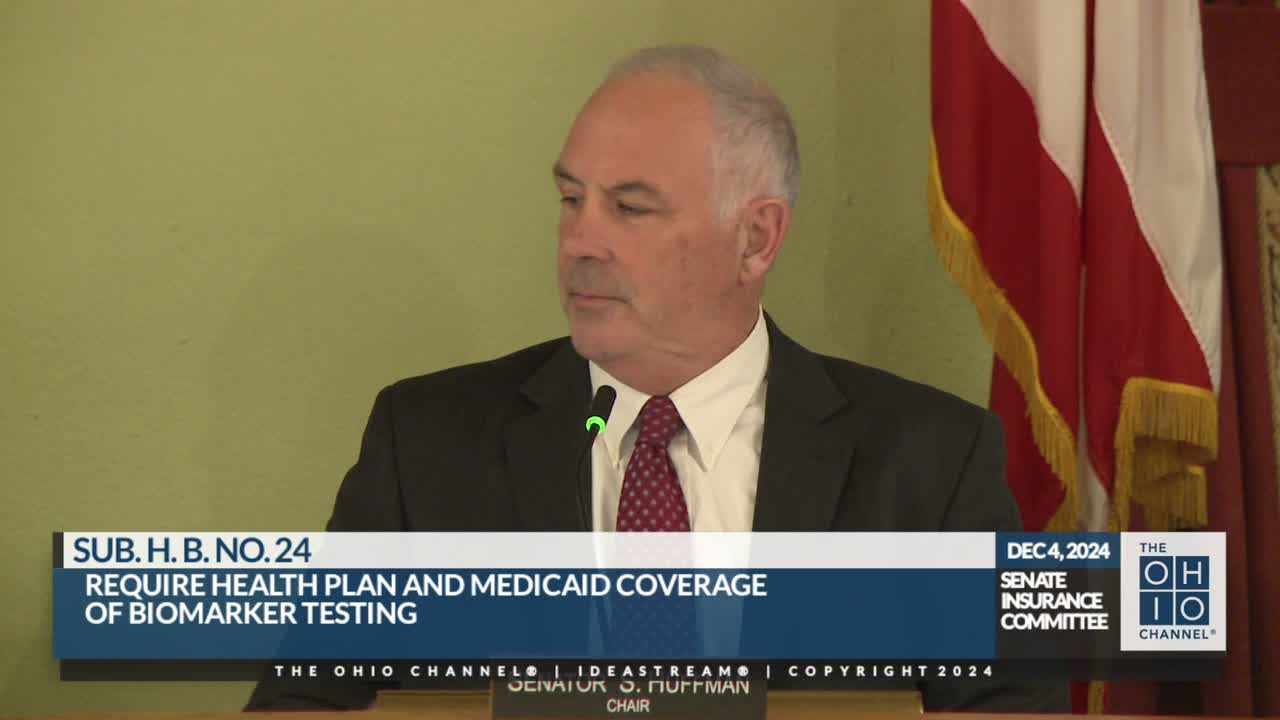
The Senate Insurance Committee held a third hearing on House Bill 24, which would require health plans to cover biomarker testing. Two opponent witnesses — Megan Richwine, Director of Government Affairs for the Ohio Association of Health Plans (OAHP), and Chris Feruso, state director for NFIB — told senators they support access to clinically appropriate testing but urged caution about a blanket coverage mandate.
Megan Richwine said many health plans already cover biomarker tests that meet a health plan's medical-necessity criteria and warned the bill, as drafted, could strip plans of the ability to apply those criteria. "Today health plans cover biomarker tests that meet the health plan's medical necessity criteria," she told the committee, while also arguing that removing that discretion "can no longer effectively manage the care rendered to its members." Richwine said plans negotiate pricing and employ medical professionals to evaluate clinical appropriateness; she said dramatically limiting plans' review authority would reduce incentives for testing companies to negotiate lower prices and could result in higher premiums for members.
Committee members pressed Richwine on where insurer authority should intersect with a prescribing physician's judgment. Senator Schaeffer asked how to resolve cases where a licensed clinician prescribes a treatment or test but an insurer denies coverage. Richwine replied that plans use medical-necessity criteria and that she could follow up with more specifics, acknowledging some details were outside her immediate expertise.
Chris Feruso, representing nearly 21,000 NFIB small-business members, said the bill raises equity and cost concerns because many private-sector, self-insured ERISA plans are exempt from state mandates. He urged the committee to consider mechanisms to limit reimbursement growth, citing Ohio Legislative Service Commission and Milliman data that the LSC fiscal note drew on an average allowed unit cost of about $224 per test for private plans and roughly $80 for Medicaid. Feruso noted other studies showing test costs can range from about $50 to more than $10,000 for complex tests and suggested the General Assembly consider a reimbursement cap (he referenced an existing statutory example that caps mammography reimbursement at 130 percent of the Medicare rate) to avoid runaway costs.
"That's the most important thing here. We need to recognize we're talking about patients, their families, and their well-being," Feruso said, while also warning that passing mandates without cost limits can shift real costs onto small employers and plan purchasers. He also told senators the federal ERISA exemption means the mandate will not reach many self-insured employers, producing gaps in coverage and distributional effects across employers and markets.
Committee members asked whether biomarker tests can be patented or sold exclusively, and whether technological improvements will drive prices down over time. Witnesses said exclusivity and limited competition could allow vendors to set high prices; they also cautioned that medical technology does not always produce lower consumer costs over time in the same way consumer electronics do. Witnesses offered to follow up on technical questions, such as exact coverage practices across specific carriers and patent issues.
The committee entered written business testimony for the record from the business community, heard no further witnesses, and adjourned.