
North Dakota Supreme Court hears arguments over excluded impeachment evidence and life‑expectancy sentencing calculation
Get AI-powered insights, summaries, and transcripts
Subscribe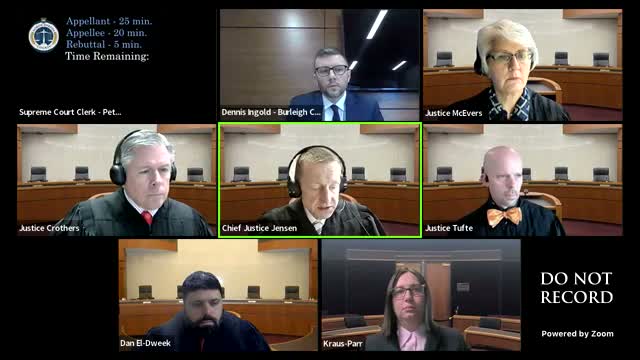
Summary
At oral argument in State v. Taylor, defense counsel said a trial judge improperly blocked cross‑examination and playing a recorded interview crucial to a self‑defense claim; the State disputed the claim and defended the court’s use of the life‑expectancy table. The court took the case under advisement.
The North Dakota Supreme Court heard arguments in State v. Taylor over whether a trial judge wrongly curtailed the defense’s cross‑examination of a State witness and whether the court improperly applied a life‑expectancy table in sentencing.
Appellant’s counsel, Miss Krausbaugh, told the court she was presenting three issues for review: (1) whether the jury’s verdicts were unanimous, (2) whether the district court abused its discretion by preventing impeachment of a State witness (identified in the record as Mr. Lowy), and (3) whether the court imposed an illegal sentence by the manner it referenced the life‑expectancy table. Krausbaugh argued the district court sustained a “general objection” without stating a basis, which shut down defense impeachment and forced counsel to change tactics, including attempting to refresh recollection and to play a recorded interview the court refused to admit.
Why it matters: Krausbaugh said the excluded evidence went to the core of Taylor’s self‑defense theory and that the exclusion was prejudicial. “Were you telling the truth when you did that interview?” she asked during cross‑examination, a line of questioning she said the trial court cut off when the State objected and the court sustained without explanation.
State counsel, Mister Ingold, disputed the defense’s framing. On the unanimity point he said the record shows the trial court asked the jury whether the verdicts were unanimous and that the jurors “all nodded affirmatively.” Ingold also argued that the defense never made a formal offer of proof identifying the prior statement it sought to admit, a procedural step that, in his view, limited appellate review. He pointed to Supreme Court administrative Rule 51 and the life‑expectancy table cited in the sentencing record, saying the rule directs the court to compute remaining life expectancy “by reference” to the table as a starting point.
The justices questioned both sides about procedural details: whether a single sustained question on the record was the linchpin that prevented subsequent impeachment, whether the defense had the recording or statement available at trial, and whether excluded content later appeared in other witnesses’ testimony so that any error would be harmless. Counsel and justices also debated whether an officer’s written report or a recorded interview could qualify as a recorded recollection under the rules of evidence and whether the witness ever adopted the report.
State v. Taylor remains under advisement. The court did not announce a decision and adjourned until 1:30 PM; the justices will issue their ruling after internal deliberation.
Sources: Statements and exchanges during oral argument before the North Dakota Supreme Court; specific references include counsel argument about impeachment and the question, “Were you telling the truth when you did that interview?” and the State’s representation that jurors “all nodded affirmatively.”
Ending: The court took the case under advisement and adjourned until 1:30 PM; no opinion was released at argument’s close.