
N.D. Supreme Court Hears Appeal Over Plea Factual Basis and Suppression Claims
Get AI-powered insights, summaries, and transcripts
Subscribe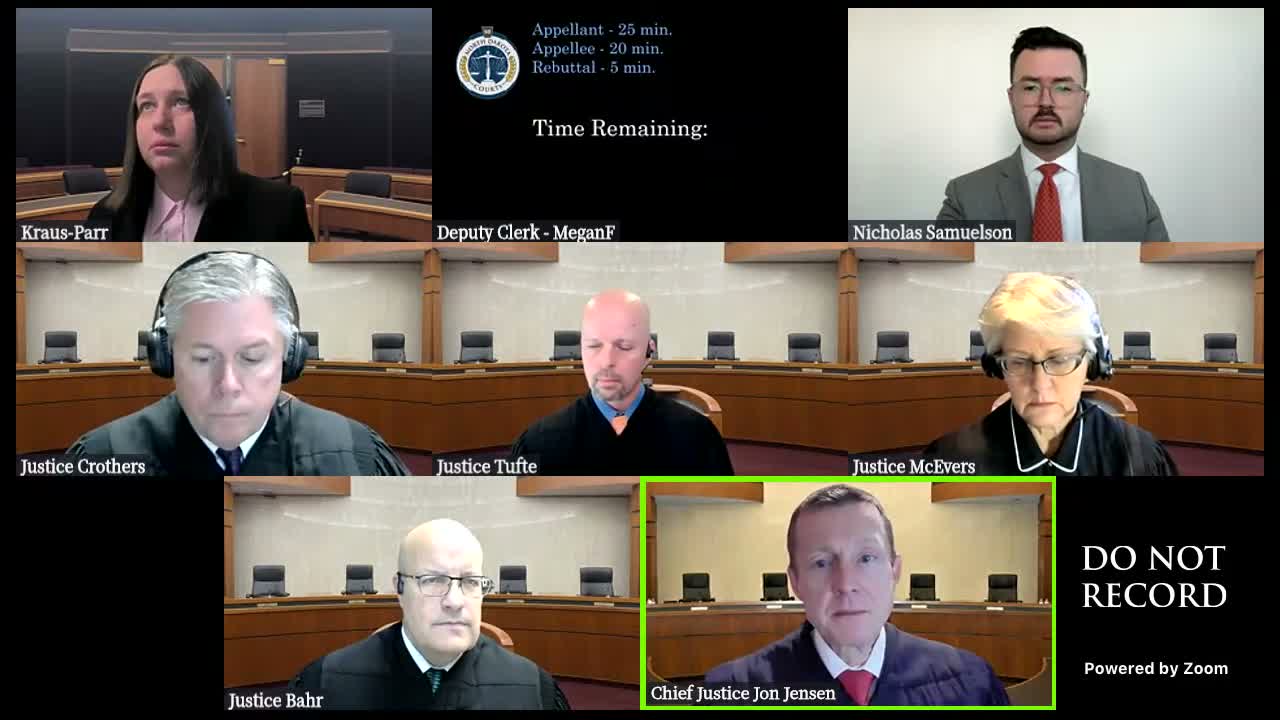
Summary
The North Dakota Supreme Court heard consolidated arguments over whether a district court failed to establish a sufficient factual basis under Rule 11 before accepting a guilty plea in one case and whether statements should have been suppressed as custodial interrogation in two related cases.
The North Dakota Supreme Court heard oral argument in two consolidated appeals (file numbers 20240186 and 20240187) over whether a district court erred by accepting a guilty plea without establishing a sufficient factual basis under Rule 11 and whether statements made during arrest should have been suppressed.
Appellant counsel Kira Kraussbar told the court she represents Cody Lee Little Ghost and urged that the February 2023 case (filed as 0951) lacks any factual recital at the change-of-plea hearing. Kraussbar said the judge merely recited charging language and did not incorporate facts from earlier proceedings or ask the defendant to agree to underlying facts, arguing that omission undermines the knowing, voluntary nature of the plea. "Rule 11 is mandatory on the court," Kraussbar said in rebuttal.
The state, represented by Nicholas Samuelson, urged the court to affirm. Samuelson said the record contains an incident report, an affidavit of probable cause and testimony from arresting officers that together supply a factual basis for the charged conduct. He also separated the consolidated matters, arguing the June 2023 case (file ending 2614) included a factual basis at the plea colloquy to which Little Ghost agreed and should be affirmed. "From these, the court could conclude that Little Ghost did spit on the officers while they were acting in their official capacity," Samuelson told the justices.
Kraussbar also challenged the denial of motions to suppress in both cases. She argued certain statements and conduct cited at the suppression hearings — including the defendant's expletive-filled exchanges with officers and an on-the-record admission that he had taken fentanyl earlier in the day — could have been elicited in custodial interrogation and therefore should have been suppressed. The state conceded no Miranda warning was given in the February 2023 matter but contended there was no custodial interrogation on the charged offense and no incriminating answers attributable to questioning that would require suppression.
The justices questioned both sides about the record: whether a contested preliminary hearing and suppression hearing had generated facts the district court could reference, whether the same judge handled related proceedings, and how to assess prejudice under the obvious-error standard when Rule 11 compliance was not objected to below. The state framed the appellate inquiry as a three-prong obvious-error review (error, obviousness, prejudice) and argued the defendant cannot satisfy those prongs; the appellant argued Rule 11 noncompliance can be per se prejudicial and requires withdrawal of the plea to correct manifest injustice.
Arguments concluded with counsel citing case law and the bench reserving decision. The court did not announce a ruling at the close of oral argument.