
Virginia advisory group: more than 11,100 children on childcare subsidy wait list; panel weighs co‑pay and eligibility changes
Get AI-powered insights, summaries, and transcripts
Subscribe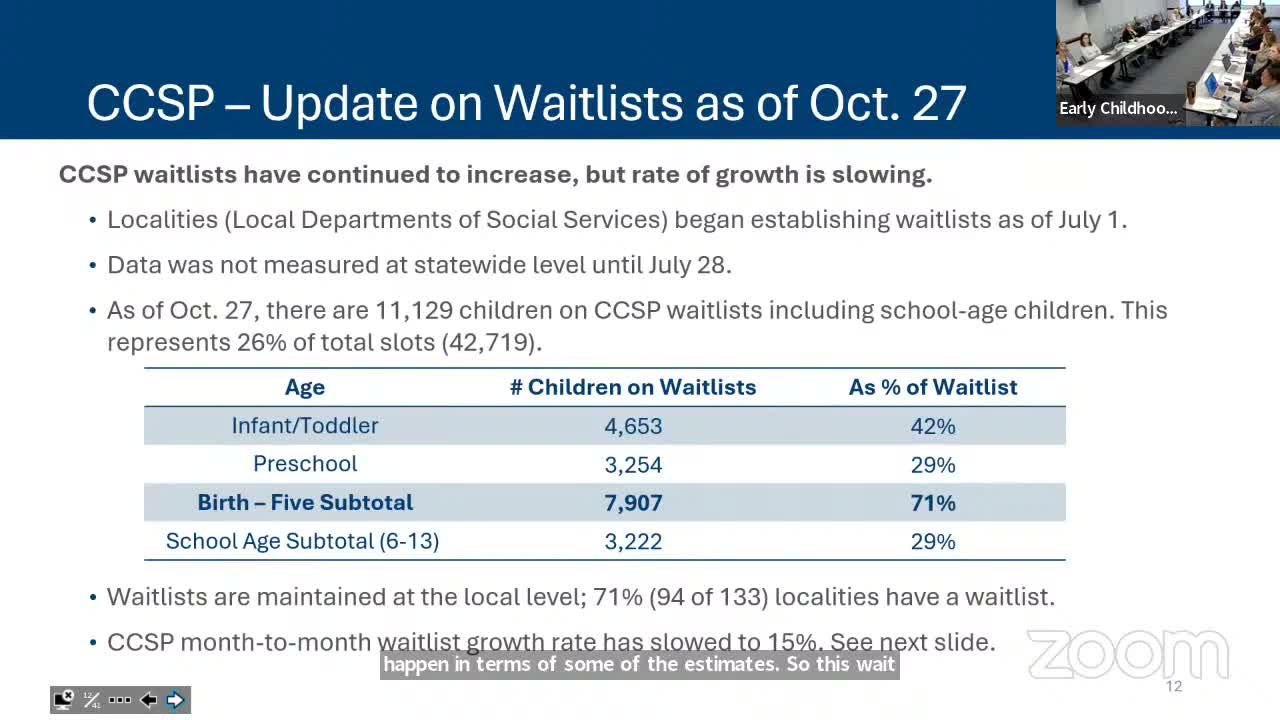
Summary
Department of Education staff told the Early Childhood Advisory Committee that as of October the childcare subsidy wait list exceeded 11,100 children and described policy options — higher family co‑payments, time‑limited job‑search eligibility and reallocating unused VPI funds — that could free slots but carry trade‑offs for families and providers.
Department of Education staff told the Early Childhood Advisory Committee in November that more than 11,100 children were on the state’s childcare subsidy wait list in October, with infants and toddlers accounting for the single largest age group.
The advisory group heard commission findings and policy options aimed at making limited state dollars reach more families as lawmakers prepare budget decisions for the 2025 session.
Staff described three main levers discussed by the commission: modest increases in family co‑payments, time limits on job‑search eligibility for subsidy, and the statutory ability to reallocate unused Virginia Preschool Initiative (VPI) funds to subsidy slots. On co‑payments, staff said the current flat rate approach results in about 2.5–3% of families contributing; federal rules allow a higher cap (up to 7%), and the commission considered both moving to the 7% cap and doubling current flat rates. Analysis presented to the panel estimated that raising co‑payments could free roughly 1,600–3,000 subsidy slots, though staff cautioned that collecting higher co‑payments shifts administrative burden to private providers.
On job‑search eligibility, staff described an option permitted under federal guidance to time‑limit subsidies for families who are only job searching; preliminary estimates suggested limiting that eligibility could free about 1,000 slots, but staff emphasized that changing the rule could also change family behavior and therefore the realized savings.
Staff also explained how VPI budgeting and enrollment interact. The state funded 24,842 VPI slots for FY25 and had enrolled roughly 23,133 children by the October snapshot; where allocated slots go unused, staff said statutory reallocation authority (referenced in the commission materials as Senate bill 54 and 419) could allow DOE to transfer dollars to childcare subsidy slots to reduce the wait list.
Committee members pressed staff on local variation, provider impacts and equity. A member noted that many subsidy families work in in‑person industries (health care, education, retail and local government) and that increasing co‑payments or imposing time limits could have disproportionate effects on families who cannot telework. Staff responded that analyses try to account for employer and regional differences but that many uncertainties remain.
The committee made no formal votes — staff said there was not an in‑person quorum — and the presentation was treated as an informational briefing to inform members and prepare the commission’s recommendations and the governor’s budget process.
Next steps: staff will continue refinement of modeling and present commission reports and possible budget language to the general assembly; any statutory or budget changes would be decided through the governor’s budget and the legislative process.