Get Full Government Meeting Transcripts, Videos, & Alerts Forever!
Get email alerts on the Body Worn Camera Policy topic
No spam. Unsubscribe anytime.
San Francisco Police Commission hearing spotlights split on officer review of body‑worn video
Summary
A working group presented a draft body‑worn camera policy to the San Francisco Police Commission on Sept. 16, 2015; members praised cameras for transparency but disagreed over whether officers should view footage before writing reports and how long footage should be retained.
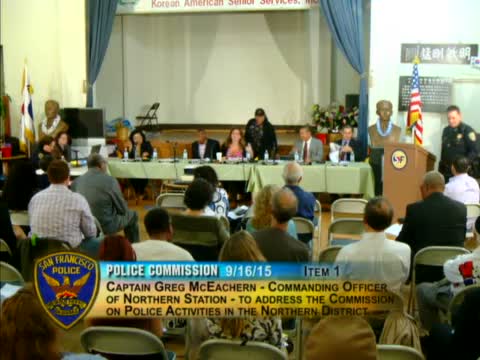
San Francisco — The San Francisco Police Commission brought its draft body‑worn camera policy to the Northern District on Sept. 16, 2015, where a working‑group presentation and lengthy public comment highlighted two areas without consensus: whether officers may review footage before writing reports or giving statements in certain investigations, and how long video files should be retained.
Commission President Susie Loftus opened the special neighborhood meeting by saying the commission asked the department to assemble a diverse working group to produce a policy for review. Commander Bob Moser, co‑chair of the working group, said members met publicly over several months, reviewed model policies and research (including policies from Oakland, LAPD, BART, San Diego and DOJ/PERF guidance), and forwarded a draft dated Aug. 11, 2015, to the commission.
Moser said the group agreed that officers should not be required to record every minute of their shift but should activate cameras for clearly defined events. Two topics, he said, spanned multiple meetings and produced competing viewpoints: whether officers should be allowed to view footage before preparing reports or being interviewed, and the length of retention for stored footage (the draft suggested one year; some members advocated two years).
Joyce Hicks, director of the Office of Citizens’ Complaints and a working‑group member, said the OCC supports prompt implementation but urged limits on officer review when an officer is a subject or witness in an active misconduct, in‑custody death or officer‑involved shooting investigation. "Exposing officers to events which they may not have been privy to at the time affects the ability of investigators to assess the officer's contemporaneous appraisal," Hicks said, and recommended that officers provide an initial statement before viewing footage and then be allowed to submit a supplemental statement.
The police union took the opposite stance on the review issue. Marty Halloran, president of the San Francisco Police Officers Association, said officers should be permitted to view footage before writing incident reports or giving statements, arguing that video improves accuracy and protects both officers and the public. He cited academic and Department of Justice research presented to commissioners and warned that denying review could reduce voluntary statements in serious investigations.
Several officers and union representatives who spoke at the meeting reinforced Halloran's point. Sergeant Scott Edwards and other frontline officers described "tunnel vision" and other stress‑related memory limits in critical incidents and said camera footage can help create more complete and accurate reports. Officers also raised practical concerns about personnel time: requiring a first draft before review and then a supplemental report could pull officers off patrol.
Civil‑liberties and community advocates urged a more restrictive approach. Tessa D'Arcangelo of the ACLU of Northern California and others said video captures only certain angles and can reshape testimony if officers see footage before reporting. The ACLU and allied civil‑rights groups submitted a written letter to the working group raising transparency and accountability concerns and urging safeguards that would prevent footage review from becoming a tool to alter investigations.
Retention also divided the panel. Some working‑group members recommended a one‑year retention baseline; others argued for two years. Moser said the group recommended a cost‑benefit analysis of storage options tied to the system the city ultimately purchases, because retention is directly linked to exponential storage costs.
Public comment reflected wide public interest: victims' family members pressed for thorough investigations, neighborhood advocates emphasized cameras’ value in mental‑health encounters, and several community groups emphasized conditional limits on review to preserve investigative integrity. A portion of the public comment session included expressive remarks not directly tied to the technical policy choices (poems and broad political statements), but most speakers focused on the two contested issues.
The commission did not take a vote on policy language at the meeting. Commissioners asked legal and operational questions about voluntary versus compelled statements, the 'live‑barter' (Miranda/Liberty admonition) process, and whether prohibiting review in certain categories might discourage voluntary statements. The chief and legal advisers clarified that compelled statements have different admissibility rules than voluntary statements, a point that figured into the discussion about incentives for officers to cooperate with investigations.
Next steps: the commission will accept written comments and further testimony and is expected to refine the draft policy and deliberate on the specific exceptions and retention parameters before formally adopting a department general order.