Get Full Government Meeting Transcripts, Videos, & Alerts Forever!
Get email alerts on the Domestic Violence Policy topic
No spam. Unsubscribe anytime.
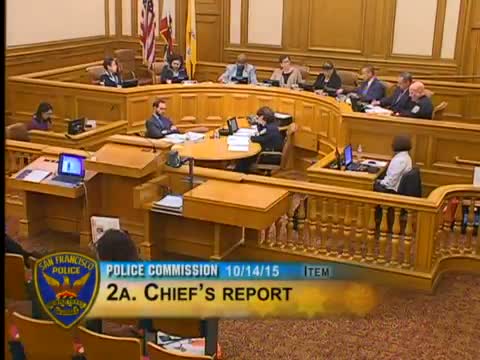
Police Commission hears update on DGO 6.09 rollout, partners urge data and language access
Summary
Acting Captain Eddie Santos told the Commission the Department General Order 6.09 rollout is proceeding and officers have made routine cross‑referrals to Family and Children's Services; advocates praised collaboration but urged faster implementation of lethality screening, language access and data-sharing to guard against a chilling effect on survivors calling for help.
Acting Captain Eddie Santos presented the Police Commission with a progress report on Department General Order 6.09, the San Francisco Police Department's revised protocols for handling domestic violence incidents. Santos described changes in training, tools for officers and the referral process to Family and Children's Services (FCS).
Santos said recruits now receive 14 hours of domestic‑violence instruction at the academy — two hours more than the POST minimum — and officers are being issued a referral card and a ``Know Your Rights'' handout to give survivors when FCS is called. He credited Lieutenant Michael Duderoff and community advocates with refining the card's language so it can guide survivors through what to expect from cross‑reporting and from FCS.
Santos presented FCS referral counts used to assess rollout impact: in 2013 there were 254 referrals (17 children removed, six removals tied to domestic violence); 2014 saw 387 referrals (34 removed, 17 domestic‑violence related); and 2015 to date showed 364 referrals (16 removed, seven domestic‑violence related). Based on those figures he said he did not see a spike in removals tied to the new order and concluded referrals were being made appropriately.
Community partners and advocates at the meeting — including representatives from the Family Violence Council, the Child Abuse Prevention Center and Family and Children's Services — praised the partnership but pressed for better, regular data to ensure the cross‑reporting requirement does not have a chilling effect on survivors, particularly in monolingual and communities of color. Beverly Upton and others said the lethality screening questions and the Know Your Rights materials need to be fully implemented and distributed quickly.
Commissioners asked about limited English proficiency (LEP) protocols. Santos said the department has increased use of a language access line and is adding languages; he also described monthly meetings with advocates and supervisors as a venue to troubleshoot breakdowns in real time. Advocates and Family and Children's Services committed to sharing data and to working on a law‑enforcement protocol to monitor unintended consequences of cross‑reporting.
The Commission did not take formal legislative action on the matter at this meeting; members said they will continue to monitor implementation and requested follow‑up reports and data from the department and partner agencies.