Get Full Government Meeting Transcripts, Videos, & Alerts Forever!
Get email alerts on the Hunters Point Redevelopment topic
No spam. Unsubscribe anytime.
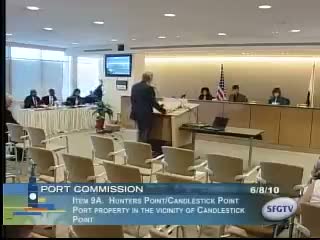
Port Commission approves CEQA findings, trust exchange and interagency agreement for Hunters Point/Candlestick redevelopment
Summary
The commission adopted CEQA findings and authorized a public-trust land exchange and an interagency cooperative agreement to advance Phase 2 of the Hunters Point Shipyard and Candlestick Point redevelopment, citing job creation, affordable housing and park space commitments.
SAN FRANCISCO ' The Port Commission voted June 8 to adopt environmental findings and approve interagency agreements that advance Phase 2 of the Hunters Point Shipyard and Candlestick Point redevelopment.
Mark Lozevoy, assistant deputy director of real estate, and Michael Cohen, director of the Office of Economic and Workforce Development, told commissioners the integrated project covers about 700 acres and is intended to deliver economic and neighborhood benefits after a multi-decade planning process. Cohen said the approvals implement a public-trust land exchange authorized by Senate Bill 792 and an interagency cooperative framework for infrastructure and permitting.
Cohen summarized public benefits included in project documents: about 10,000 permanent jobs over build-out, roughly 1,000 construction jobs per year during peak phases, 10,500 residential units with about 32% below-market-rate housing and more than 300 acres of park and open space concentrated in early phases. "We are preserving space for all of the artists there, both in renovated space and newly built space," Cohen said, describing artists as integrated into planning.
Public commenters broadly supported the project. Carolyn Diamond of the Market Street Association (read by Laura Chew) recommended approval of CEQA findings and the interagency agreement. Speakers including Corinne Woods and Saul Bloom urged careful oversight of site cleanup and timely delivery of parks and affordable housing; Bloom noted concerns about whether the DEIR fully addresses the Bay Conservation and Development Commission's Seaport Plan.
Commissioners asked for clarification about remediation and park delivery. Cohen said the U.S. Environmental Protection Agency is the lead cleanup agency for the shipyard and that EPA and state regulators must concur before land transfers, and that the Navy retains liability for certain undiscovered contamination after transfer.
The commission approved the CEQA findings and associated agreements (Resolution 10-40). The transcript records a voice vote of "Aye" with no roll-call tally printed.
Next steps include implementing the interagency cooperation framework and continuing regulatory review and public outreach as project-level phases return for further approvals.