Get Full Government Meeting Transcripts, Videos, & Alerts Forever!
Get email alerts on the SSIP topic
No spam. Unsubscribe anytime.
SFPUC reports progress on Sewer System Improvement Program; biosolids RFQ tops $800 million
Summary
The San Francisco Public Utilities Commission received a quarterly SSIP update: 70 projects active, Phase 1 about 11.4% complete, Biosolids at ~35% design with CEQA extending through Nov. 2017, and $64 million in LBE subcontracting reported. Staff highlighted workforce-development gains and upcoming contractor selections.
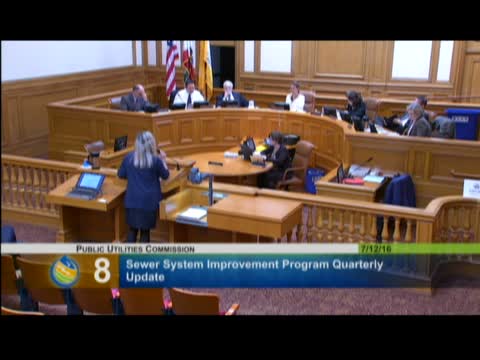
The San Francisco Public Utilities Commission on Tuesday received a quarterly briefing on the Sewer System Improvement Program that showed steady program momentum alongside ongoing environmental review and an emphasis on local hiring.
Karen Kubik, director of the Sewer System Improvement Program, told commissioners the portfolio includes 70 active projects: 49 in planning and design, five in bid and award and 10 in construction. ‘‘We are 11.4% into Phase 1,’’ Kubik said, and cautioned that overall construction activity will increase sharply over the next two years.
The Biosolids project is at roughly 35% design, Kubik said, and the California Environmental Quality Act process is expected to continue through November 2017. The commission has advertised a request for qualifications for a construction-manager/general-contractor on the Biosolids work that Kubik described as ‘‘an $800,000,000 plus RFQ.’’ Headworks and the DCS project are also moving toward construction, she said.
Kubik highlighted workforce-development metrics. She said 19 prime contracts are active (10 professional services, nine construction) and that two‑thirds of subcontracts—156 subcontracts totaling about $64,000,000—have gone to 105 local business enterprises. ‘‘Nearly 40% of all hours worked on the SSIP have been performed by San Francisco residents,’’ she said, adding that those residents have earned ‘‘almost $6,000,000 in wages and benefits’’ through March 2016.
Commissioners pressed for more frequent updates and more detail on pre‑apprenticeship and mentorship pathways into construction trades. One commissioner asked staff to return with a more comprehensive, PUC‑wide workforce development presentation; Kubik and staff agreed to schedule further briefings.
Kubik also reviewed community outreach work, saying SSIP teams have held dozens of stakeholder meetings, hosted tours and run Metroquest online surveys to collect input from neighborhoods that include Dogpatch, Potrero Hill and Bayview-Hunters Point.
The commission did not take any immediate action on the SSIP items beyond accepting the quarterly update. Kubik said she will return to the commission for the next regular quarterly report and offered to provide a supplemental written summary quantifying outreach and engagement numbers.