Get Full Government Meeting Transcripts, Videos, & Alerts Forever!
Get email alerts on the Body Worn Camera topic
No spam. Unsubscribe anytime.
Police Commission reviews draft body-worn camera policy amid debate over officer review and retention
Summary
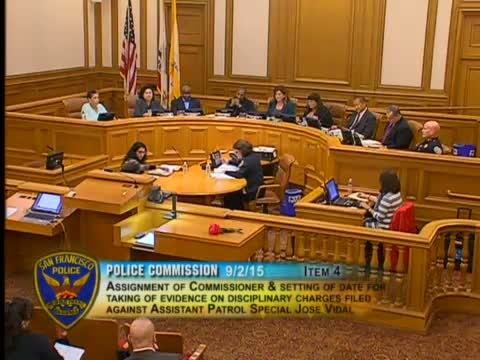
A working group delivered a draft body-worn camera policy to the San Francisco Police Commission on Sept. 2; commissioners and community members sharply debated whether officers should be allowed to view footage before giving statements and how long routine footage should be retained.
The San Francisco Police Commission heard a presentation Sept. 2 on a draft body-worn camera policy produced by a six-meeting working group that included SFPD command staff, the Office of Citizen Complaints (OCC), the Public Defender—s Office, police employee groups and community representatives. Commander Robert Mosier, co-chair of the group, said the draft reflects months of public meetings and model policies and was unanimously approved by group members to be forwarded to the Commission for deliberation.
Why it matters: The policy will govern when officers must activate cameras, when recordings may be terminated, who may view footage and how long routine recordings are retained. Those rules will affect investigations, transparency to the public and officers— day-to-day reporting.
The working group—s process and scope were defended by Mosier and Director Joyce Hicks of the OCC, who said meetings and drafts were posted online and open to public comment. Mosier said the group met six times over the summer and considered model policies from agencies and organizations including PERF, ACLU and other municipal police departments.
Where the draft divides opinion: Two areas drew the most contention. Deputy Public Defender Rebecca Young said the current draft—s language on termination of recordings (subsection E) and on officer viewing of recordings (subsection F) is "too broad and ill defined," granting excessive discretion to officers and supervisors. She urged the Commission to consider the New York Police Department Office of Inspector General—s audit, which recommended that officers involved in disciplinary investigations not view relevant footage until after giving statements.
"The way it is written now is simply too broad and it's ill defined," Young said, pressing for clearer limits when officers may view footage in the context of internal or external investigations.
By contrast, Marty Halloran, president of the San Francisco Police Officers Association, and POA attorney Jonathan Yank stressed that allowing officers to review footage before writing incident reports often produces more accurate and complete reports. Halloran said officers are routinely advised to give voluntary statements in critical incidents and that withholding footage could discourage cooperation.
"Depriving officers of video that contains information directly relevant to their conduct can set them up for failure," Yank said, citing research suggesting viewing video can improve reporting accuracy.
Other contested points included activation triggers (whether officers must activate cameras "prior to" listed events or "as soon as practical," and use of camera buffers that capture seconds before activation), retention of routine footage (the working group debated 1 year versus a 2-year minimum and recommended a cost-benefit analysis), notification and public access rules, and whether the draft should spell out minimum disciplinary consequences for noncompliance.
Commissioners emphasized clarity and public input. Commissioner De Jesus and others asked for more explicit language on activation (vehicle pursuits, use-of-force, foot pursuits), earlier-draft phrasing that once said "prior to" initiation of listed circumstances, and clearer consequences for failure to activate or improper release. Director Hicks noted the OCC's recommendation that officers not be permitted to view footage after notice of an administrative or criminal investigation and that they be allowed to submit a supplemental statement after viewing when appropriate.
Next steps: The Commission set two public meetings for additional community input (the first scheduled for Sept. 16 at a Northern Police District site) and signaled that the draft will be the same version presented to the public so comments can be compared directly with the working-group minutes posted online. Commissioners acknowledged further labor meet-and-confer obligations before any final departmental general order is adopted.
The Commission did not adopt the policy at the Sept. 2 meeting; it instead opened public comment and scheduled further public meetings and deliberations.