Get Full Government Meeting Transcripts, Videos, & Alerts Forever!
Get email alerts on the Coastal Protection topic
No spam. Unsubscribe anytime.
SFPUC outlines Ocean Beach protection plan, short‑term sand placements and 2021 long‑term start
Summary
SFPUC staff updated commissioners on short‑ and long‑term measures to protect critical wastewater infrastructure and the coast at South Ocean Beach, including sand placement under a six‑year permit, interim 'soft' protections and long‑term concepts such as managed retreat, low‑profile walls and a possible Army Corps cost‑share to bring dredged sand.
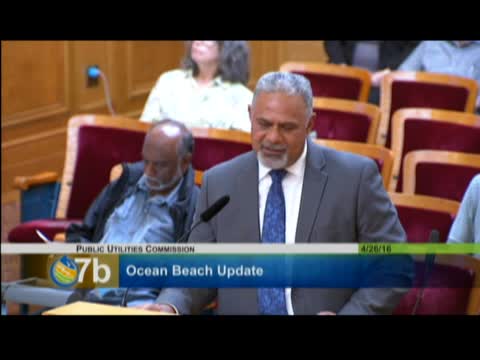
Zanna Roche, Climate Change and Special Projects Manager for the Wastewater Enterprise, told the San Francisco Public Utilities Commission on April 26 that the agency is pursuing a two‑pronged approach to chronic erosion at South Ocean Beach: continued short‑term sand placements and a long‑term alternatives analysis aimed at construction beginning around 2021.
Roche said the Ocean Beach master plan study area stretches from the Cliff House to the Fort Funston bluffs and that the sites of greatest concern include the Oceanside Treatment Plant, the Lake Merced Tunnel and the West Side transport boxes. “This is the area that is experiencing chronic erosion that we are trying to protect,” she said, noting staff have already used sand placements and sandbags successfully during severe seasons.
The short‑term approach relies on softer measures the commission has implemented under annual permits; Roche said the PUC secured a six‑year Coastal Commission permit in 2015 that allows more rapid, as‑needed sand placement and related actions. She said staff completed a sand placement earlier in the month at the same location used in 2014 and credited the proactive permitting approach for protecting the coast through recent El Niño conditions.
For the long term, staff are analyzing managed retreat, structural protection (including low‑profile walls), sand nourishment and adaptive management. Roche described a vision that includes removing a portion of the Great Highway between Sloat and Highway 35 to create space for the coast to migrate naturally, maintain access to the Oceanside Treatment Plant, and extend a continuous promenade and safer bicycle and pedestrian access.
The PUC is coordinating with Recreation and Park, the San Francisco Municipal Transportation Agency, the Golden Gate National Recreation Area and the U.S. Army Corps of Engineers. Roche said the Corps dredges the Golden Gate shipping channel and currently disposes material offshore; the PUC is negotiating a cost‑share agreement to bring an estimated 400,000 cubic yards of dredged sand to South Ocean Beach, with target implementation in 2017–2018 to augment PUC efforts.
Commissioners asked about timelines for protections for large transport boxes and a Lake Merced tunnel that runs under the Great Highway; Roche said short‑term measures are expected to carry the system through 2050 under current projections while adaptive management and additional data collection will guide later steps. She also confirmed staff are seeking grant funding and coordinating work orders with Public Works to pursue remaining Boating and Waterways grant funds (around $500,000 noted in the discussion).
The presentation concluded with an outline of monitoring, permitting and interagency agreement work that staff said is necessary before major long‑term construction begins.
Looking ahead, Roche said the PUC will continue regular public engagement and technical analysis as the alternatives proceed toward final design and environmental review.