Get Full Government Meeting Transcripts, Videos, & Alerts Forever!
Get email alerts on the Community Engagement topic
No spam. Unsubscribe anytime.
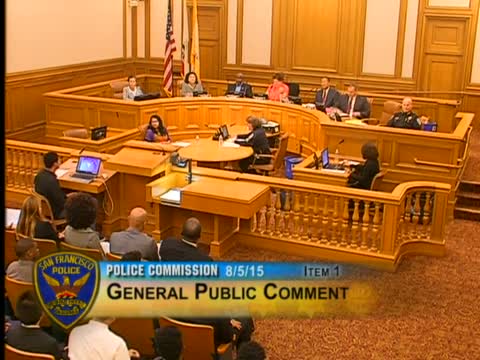
Youth interns present recommendations to San Francisco Police Commission on recruitment and community engagement
Summary
Student cohorts from the Community Safety Initiative presented projects recommending recruitment pathways, recurring community events and a voluntary anonymous-tip app to improve relations between neighborhoods and law enforcement; the Commission and chief pledged follow-up and possible ambassador roles.
Students and staff from the Community Safety Initiative told the San Francisco Police Commission on Aug. 5 that peer-led summer cohorts produced concrete recommendations to rebuild trust between police and the neighborhoods they serve.
"We did some surveys of these young people— at the beginning they said we had about 66 of them say absolutely not [to policing]... now we have 20% of them saying absolutely not," Cheryl Davis, a program lead, told the commission, citing pre- and post-program survey results that program organizers said showed a measurable shift in attitudes. Davis also said "100% of them say that they now see law enforcement differently than when they first started the program." The cohorts, some recruited from HOPE SF neighborhoods, produced apps, social-media campaigns, documentaries and skits to illustrate their suggestions.
Cohort leaders recommended several repeatable tactics: a dedicated SFPD Instagram presence to promote community events; a Facebook page for residents to highlight positive interactions; recurring community barbecues and sports days to build consistent personal contact; foot patrols and youth visits to police stations; and a proposed anonymous-tip feature in an app to allow residents to provide information without fearing retaliation. Students demonstrated short skits and previewed a short documentary to show how the tools would work in practice.
Commissioners and Chief Gregory Pieser praised the students and pressed for next steps. Commissioner Wong and others called the work "groundbreaking" and asked how the recommendations could be sustained through the school year. Chief Pieser offered to provide letters of recommendation to students who apply for jobs and to explore commissioning the interns as community ambassadors to convene forums and help organize local events.
Commission members asked staff to pursue partnerships that would keep the program active beyond eight weeks and to explore connections to workforce-development programs. Commissioner Malara (spelled variously in the transcript) and others encouraged young women in particular to consider law enforcement careers.
The Commission committed to review the interns' written materials and to report back to the students on which recommendations the department would implement. The presenters said the summer program involved roughly seven cohorts and close to 70 participants.
The presentation concluded with applause and an explicit pledge from the chief and the Commission to follow up on proposed ambassador roles and community events.
The Commission did not take any formal legislative action on the recommendations at the Aug. 5 meeting; it directed staff to return with options for continuing the program and exploring partnerships with workforce-development staff.