Get Full Government Meeting Transcripts, Videos, & Alerts Forever!
Get email alerts on the OIS And Body Cameras topic
No spam. Unsubscribe anytime.
Police Commission hears detailed OIS investigation briefing; directs working group for body‑worn camera policy
Summary
The Police Commission received an extensive briefing on the San Francisco Police Department’s officer‑involved shooting (OIS) investigation process and voted to form a multi‑stakeholder working group to draft a body‑worn camera policy, with a 30‑day progress report and a 90‑day draft requested.
The San Francisco Police Commission on May 6 heard a detailed presentation on the department’s officer‑involved shooting (OIS) investigation process and directed staff to form a working group to draft department policy for body‑worn cameras after the mayor allocated funding.
Sergeant John Crudo of the Internal Affairs Division, who leads the department’s OIS team, described how two parallel investigations usually begin after an OIS: a criminal probe handled by the homicide detail and the district attorney’s office, and a separate administrative (personnel) investigation handled by Internal Affairs. “An officer involved shooting or OIS is an intended use of a firearm at a suspect or an unintended discharge of a firearm that results in injury or death,” Crudo said, summarizing the department’s definitions and the roles of homicide, the DA and IAD.
Crudo outlined the sequence that typically follows: scene preservation and notification; homicide’s criminal investigation and interviews; a DA determination that often influences administrative timelines; and an Internal Affairs synthesis that is reviewed by the Firearm Discharge Review Board (FDRB). He told commissioners the department maintained a running five‑year case list, that 18 OIS investigations were open as of early April, and that, depending on criminal review timelines, administrative work can be paused or “tolled” under the Public Safety Officers’ Bill of Rights.
Commissioners pressed for clearer public explanations of the process and its time frames. Crudo acknowledged variability in case length, saying DA review and criminal dependencies can stretch work into months or longer, and recommended the commission consider public‑facing flowcharts and briefings to help community members understand how and why investigations take time.
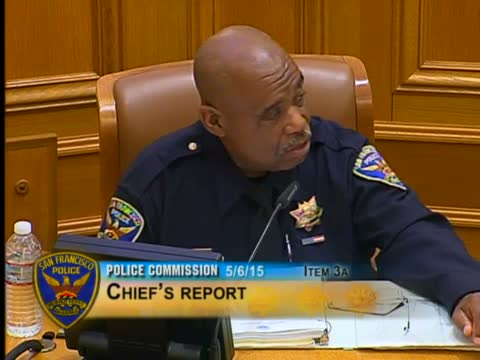
Separately, commissioners and department leaders discussed body‑worn cameras. The chief reported that Mayor Lee had identified $3 million to $4 million to equip officers who have public contact with body cameras, removing the primary financial obstacle. The commission then directed the chief to assemble a policy working group that includes community representatives, OCC staff and legal and labor stakeholders; commissioners asked for a 30‑day progress report and a draft policy within 90 days to allow for community meetings and additional review.
Votes at a glance: the meeting record shows a consent calendar motion to receive the Q1 disciplinary and OCC status reports that passed by voice vote, and a later motion to move into closed session on confidential personnel matters (both actions were recorded as approved during the meeting).
What happens next: the commission will receive the working‑group status report in 30 days and a draft body‑worn camera policy in roughly 90 days; the FDRB will continue quarterly reviews of closed OIS investigations and provide summary letters to the commission after the chief’s decision.