Get Full Government Meeting Transcripts, Videos, & Alerts Forever!
Get email alerts on the Budget Finance topic
No spam. Unsubscribe anytime.
SFPUC lays out budget framework and drought scenarios; staff warns of multi‑million-dollar revenue shortfalls
Summary
SFPUC staff told commissioners on Sept. 8 that drought-driven lower water sales could reduce operating revenue by millions and that the 10‑year capital plan — roughly $8.2 billion — will push debt service higher. Staff recommended a mix of short‑term expenditure controls, reserve use and longer‑term rate design changes.
Eric Sandler, the San Francisco Public Utilities Commissionassistant general manager for business services and chief financial officer, told the commission on Sept. 8 that the agency faces a revenue risk from sustained lower water sales and outlined a three‑scenario analysis to guide the biennial budget.
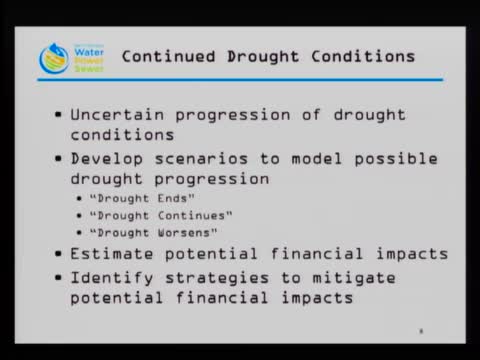
Sandler said staff modeled "drought ends," "drought continues" and "drought worsens" outcomes and used fiscal year 2017 as a representative year for the analysis. Under the optimistic scenario, staff estimated a roughly $16 million reduction in water enterprise revenue and about $19 million for wastewater; combined impacts across water, wastewater and power were portrayed as roughly 4 percent to 10 percent of projected operating uses in the representative year. "We don't know how this is going to progress," Sandler said when introducing the scenarios, urging planning that spans short, medium and long terms.
The presentation tied the revenue analysis to the commission's adopted 10‑year capital plan. Staff showed $8.2 billion in capital spending across the three enterprises through the plan horizon, with roughly $5.7 billion going to the Sewer System Improvement Program and wastewater projects. Debt service on that borrowing, staff said, will grow from about $312 million per year to roughly $850 million by 2025.
Sandler and other staff told commissioners that the PUC's revenue exposure varies by enterprise: wholesale contracts provide a multiyear true‑up that cushions volumetric volatility for about two‑thirds of sales, while retail water and, in particular, wastewater revenues are heavily volumetric (staff cited roughly 85 percent of wastewater retail revenue being volumetric). That mix amplifies the operating impact of sustained conservation. The FY2017 operating budget was presented at about $976 million, which staff used as the basis for the percent‑of‑budget calculations.
To respond, staff recommended three broad tools: targeted expense reductions (with care to avoid deferring critical capital), use of reserves where prudent, and exploration of long‑term rate design changes to increase fixed‑revenue components. Sandler said short‑term austerity can be wise but cautioned against cutting essential capital projects that preserve system reliability. Staff also flagged one‑time revenue opportunities such as potential land sales to help in the near term.
Commissioners and members of the public pressed staff on details: several commissioners said conservation savings will persist and that some investments in conservation must be considered permanent, which would change long‑term rate assumptions. Others urged staff not to let fiscal caution derail major capital projects that already have financing or are needed for reliability.
Next steps: staff will continue scenario planning, update the 10‑year capital and financial plans in the budget process, and prepare proposals for possible rate‑design changes ahead of the next formal rate‑setting cycle in 2019.