Get Full Government Meeting Transcripts, Videos, & Alerts Forever!
Get email alerts on the Wastewater Cip topic
No spam. Unsubscribe anytime.
PUC reports progress on Sewer System Improvement Program; early green infrastructure outperforms expectations
Summary
Karen Kubik told the Commission the SSIP has 66 active projects and that State Revolving Loan Funds have preliminarily indicated eligibility for about $2.5 billion in low-interest wastewater loans; monitoring at Cesar Chavez exceeded expectations, removing 580,000 gallons across seven monitored sites and an extrapolated 1.7 million gallons across the full installation.
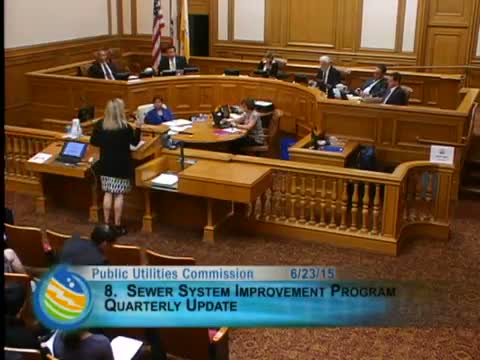
Karen Kubik, Director of the Wastewater Capital Program, briefed the Commission on the Sewer System Improvement Program (SSIP) quarterly update on June 23. She said 66 projects are underway, mostly in planning and design, and that program delivery is transitioning to more construction activity. Kubik highlighted three large pre-construction projects (Southeast Plant Headworks, Central Bayside System Improvement Project and the biosolids alternatives work) and said the environmental review process for Central Bayside has begun with a scoping meeting set for July 16 and an expected completion of the CEIR in September.
Kubik said the program has developed sea-level-rise design guidance and is coordinating regularly with an executive Management Oversight Committee. She told commissioners the State Revolving Loan Fund (SRF) preliminarily indicated potential eligibility for $2,500,000,000 in low-interest loans for wastewater projects, subject to formal applications for each project.
Kubik described green infrastructure early-implementation projects: Holloway, Mission Valencia and Sunset are moving to construction; Visitation Valley will begin later in the year. She reviewed monitoring at Cesar Chavez — seven monitoring sites captured about 580,000 gallons removed (infiltrated) during large storms and that extrapolation across the full installation suggested roughly 1,700,000 gallons removed, exceeding performance expectations. Kubik said the program will continue contractor training, certification and long-term monitoring and is exploring incentive programs (a wet-weather fee) to encourage wider adoption of green infrastructure and to manage long-term maintenance responsibilities.
Commissioners asked for the Cesar Chavez monitoring report and more information on financing assumptions, the Central Bayside alternatives and how green infrastructure performance will feed into project selection and sizing.